
Key facts: Slab leak signs
Why your ranch is a likely candidate
A post-war Richardson ranch generally sits on a concrete slab, and many have kept some original copper, galvanized or cast-iron lines [1]. Beneath is clay that swells when wet and shrinks when dry [2]. Decades of that movement, combined with ageing pipe, is why people here tend to learn the words "slab leak" sooner or later.
Not every owner will have one, and a single sign does not prove it. What you want is a calm way of ruling it in or out.
The signs, from most to least obvious
- Warm spot on the floorCheck bare feet on tile, or watch where pets choose to lie. It suggests a hot line.
- Sound of running waterListen at a quiet hour with everything turned off.
- Rising water useA bill that climbs for no reason is one of the earliest clues.
- Damp or lifting flooringCarpet that feels wet along a run, or planks that swell.
- Musty smellOften along a wall with no visible leak.
- Low pressure or a slow water heaterA hot leak can leave the heater running far more than normal.
- New cracksA weak clue on its own, because clay can do this without a leak.
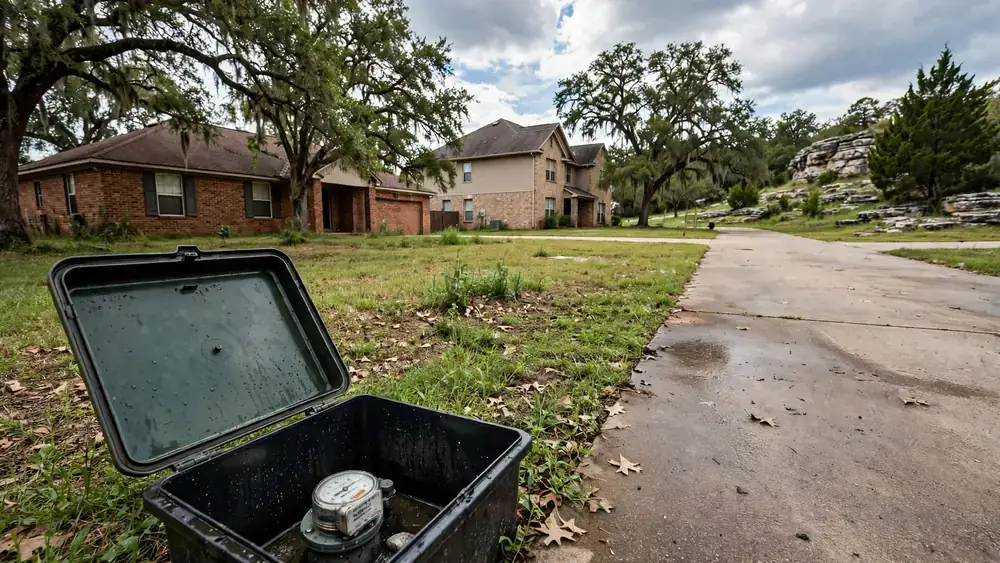
The ten-minute meter test
- 1
Turn off all water
Include the ice maker, irrigation and any softener.
- 2
Look at the leak indicator
Note the position of the small dial or the flow icon.
- 3
Wait 15 minutes
Do not use any water at all.
- 4
Look again
If it moved, water is going somewhere.
- 5
Isolate
Close the house main. If the meter stops, the leak is on the house side of the valve. If it continues, look at the line from the meter to the house.
Slab leak or something else?
| Sign | Other possible cause |
|---|---|
| Wet carpet at an outside wall | Rain, sprinklers or blocked weep holes |
| Warm floor | Duct or sunshine through a window |
| Higher water use | Running toilet or irrigation |
| Cracks | Normal seasonal soil movement |
| Musty smell | AC condensate or shower pan |
Next steps if the signs add up
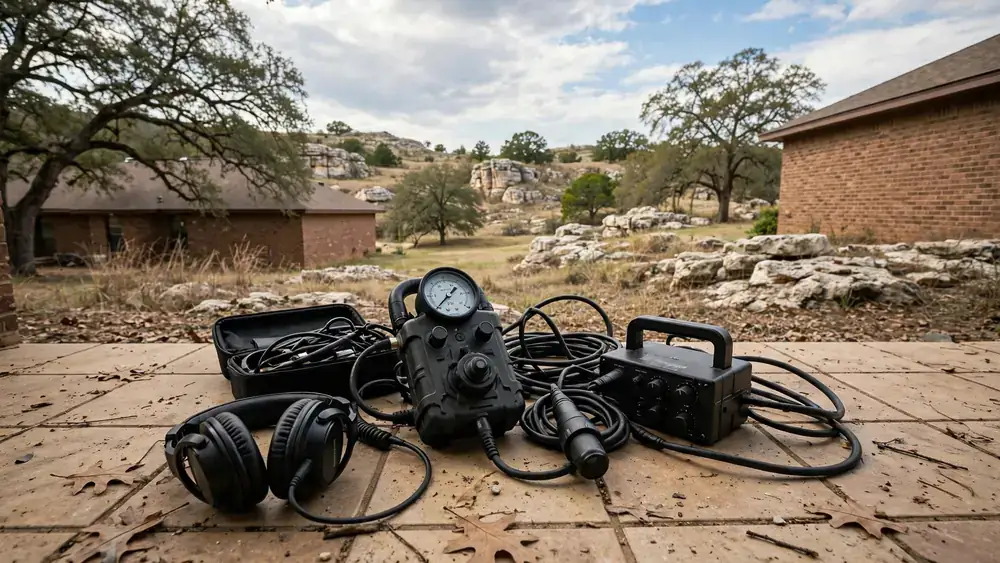
Call a licensed plumber [3] and ask for leak location, not repair yet. Pressure tests and listening gear should narrow it down before any concrete is cut. Meanwhile, if it looks like a hot line, close the cold inlet to the water heater and turn the heater off, or simply shut the main when you are not using water.
Then deal with what the water has reached. Damp flooring or wall bottoms need to be dried, and laminate over a wet slab generally has to come up. The slab leak page explains how that drying is done and what to ask for. Keep the plumber's written report for your insurer, as coverage for this type of leak depends on your policy [4].
If you are buying an older ranch, ask for a sewer camera inspection and a look at past leak repairs. The inspection report and meter test will tell you far more than a fresh coat of paint on the floor trim.
Repeat this meter test once or twice a year, and note down the results. Slab leaks often start small, and a dated log makes it obvious when the pattern changes. It also gives you something concrete to show a plumber, rather than a vague sense that the water use seems high. That habit takes only minutes, and in a sixty-year-old house it is one of the most useful things that you can do for the floors you are standing on.
Listening to your house
Older ranch houses are quiet at night, which makes this easier. Late in the evening, with appliances off, stand in the hallway and listen. Then go to the bathroom walls, and put your ear to the wall near the tub. A faint hiss or a steady rush that does not stop is worth following up. A water heater that fires up when nobody has used hot water for hours is another good clue.
Check the outside too. Look for damp soil along the foundation in dry weather, and for a patch of grass that is greener than the rest. If the weep holes in your brick are wet when it has not rained, that is worth noting. None of these proves a leak, but several together are very good reason to call a plumber.
Reading the floor by material
Each floor tells the story differently. Carpet may feel cold and damp with no visible stain, and tack strips can rust. Tile tends to stay intact, but grout lines may darken, and a warm spot is easy to detect with bare feet. Wood cups and darkens at the edges. Laminate swells at the seams and may start to feel spongy. Vinyl plank can hide water for a long time, since it does not absorb it, so check beneath it at a doorway transition.
If only one room is affected, start with the closest plumbing wall. Bathrooms and kitchens back onto bedrooms and hallways in most ranch plans. A plumbing map in your head makes the signs much easier to read. Sketch where the kitchen, baths, laundry and water heater sit, and then mark where the damp or warm places are. Lines often run in fairly straight paths between them.
Why older ranches deserve a yearly check
Age alone does not mean there is a leak, but it does mean the odds are worth watching. A house built in the late 1950s has had its pipes in the ground through more than sixty years of wet and dry seasons. Take note of the droughts and of the storms that follow them, because those shifts are when the soil moves the most. A yearly meter test, a look at your water use and a walk around the foundation will take very little time.
If you have recently had foundation work done, test again afterward, since lifting a slab can stress lines beneath it. It is a good idea to ask your foundation contractor about a plumbing test both before and after, so that any change can be identified.
When to stop watching and act
If two or more signs line up, or the meter moves in the test, stop watching and call. Waiting rarely helps with a leak under concrete.
One last check
Write down what you found, along with the date, and share it with the plumber when you call.
FAQ
Slab leak sign questions
Can a slab leak stop by itself?
Rarely. Pressurized leaks tend to grow, so test again if a sign fades.
Will my foundation fail?
A leak does not by itself mean failure, but moisture changes under a slab can add to movement.
Can I find it myself?
The meter test can show there is a leak. Finding the exact spot takes equipment.