Key facts: Fairways of Sherrill Park
How Fairways of Sherrill Park homes differ from older Richardson
A local real estate guide describes this neighborhood as lying with Crowley Park to its east, Sherrill Park to its west and East Renner Road to the north. Most of its homes went up around 1990. The same guide gives sizes of roughly 2,600 to 5,600 square feet on lots from about a sixth to half an acre. Many overlook the fairways of Sherrill Park Golf Course, the municipal course on East Lookout Drive.
That combination sets this neighborhood apart from the small one-story ranches found in older parts of the city. Taller, larger homes often place equipment and plumbing further from where a problem will be noticed. A leak in a low ranch tends to show up on the floor beside it. A leak in a big two-story house may begin in an attic or an upstairs wall and show up two rooms away.
So the question for an owner here is rarely just where the water is. It is where the water came from, and how long it has been traveling. The sections below start at the top of the house and work down to the fairway at the back of the lot.
Attic air handlers in Fairways of Sherrill Park homes
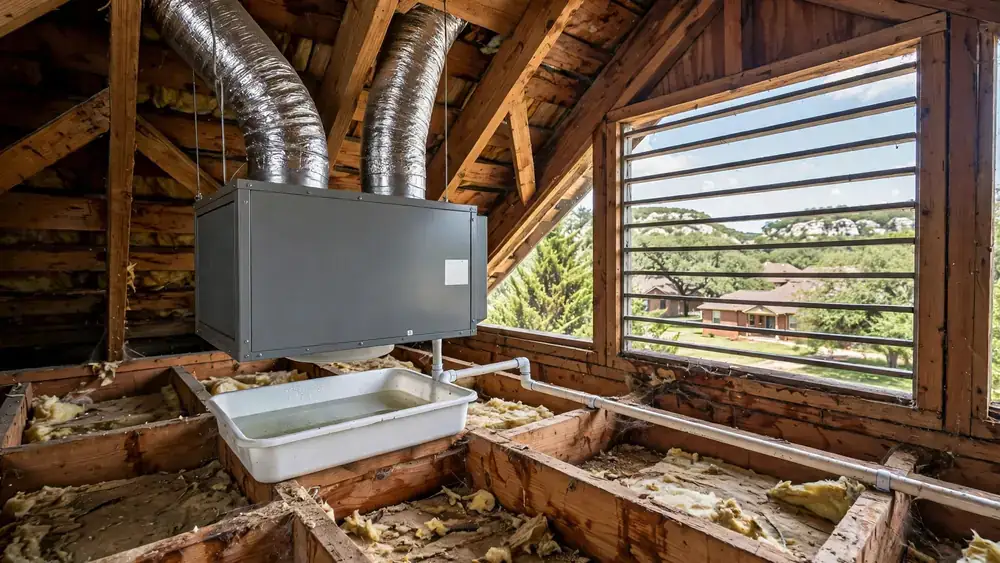
In many homes of this era and size, at least one air handler sits in the attic, with a primary drain line and usually a secondary pan beneath it. On a humid day, the coil pulls gallons of water from the air. If algae blocks the drain, the pan is the backup. If the pan is rusted or its own line is blocked, the water goes straight into the insulation and the ceiling below.
Larger homes may have two systems, so check both. Go up once before summer begins, if you can move safely on the decking, and look for standing water, rust lines or stained insulation. Many secondary drains end somewhere visible, such as over a window. Water dripping from that outlet is telling you the main drain has stopped working, even if everything looks fine indoors. Treat that as a call to your air conditioning technician. The AC leak service page explains what happens next if a ceiling has already become wet.
Wet insulation above Fairways of Sherrill Park ceilings
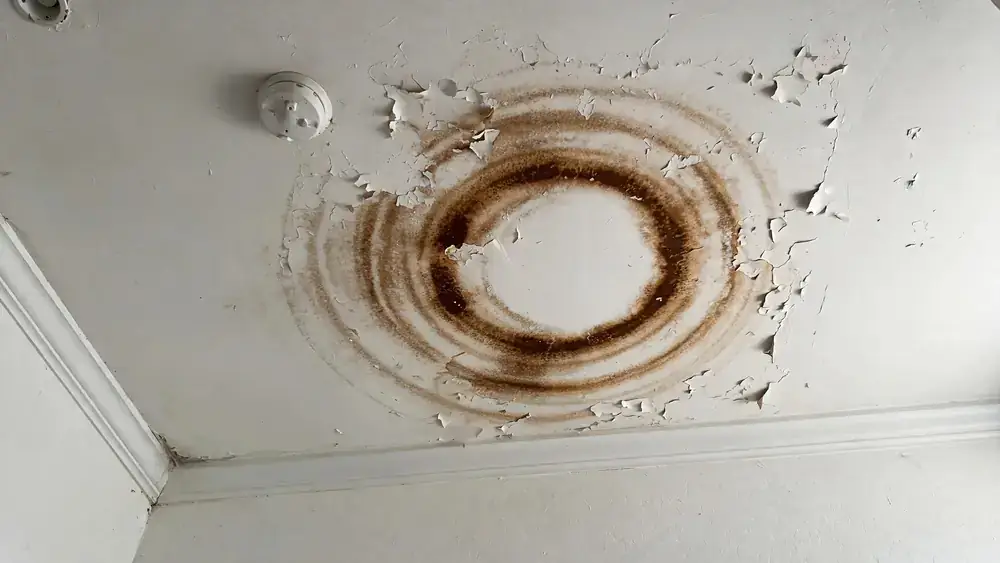
Attic insulation hides a leak very well. Blown-in material can soak up a lot of water before a stain ever comes through the drywall, and once it is wet it packs down and stays damp. Fiberglass or cellulose that has been soaked may not dry properly where it sits, and it may need to come out so that the ceiling board can dry from above.
If a ceiling sags or bulges, keep people and furniture away from it. Water-laden drywall can drop suddenly. Turn off the air conditioner if the leak seems tied to it, and turn off power to any light fixture in the wet area at the breaker. Do not poke holes in a ceiling near wiring. Only let a professional drain a bulge, unless it is clearly about to fall and you can stand clear.
Tall ceilings, popular in larger homes from this period, make these repairs harder. A stain over a two-story entry or family room usually means ladders or scaffolding for inspection and repainting. Taking clear photos with the zoom on your phone can help a contractor decide what equipment to bring. Do not climb to reach it yourself.
Upstairs laundry and baths in Fairways of Sherrill Park
Second-floor bathrooms are a common source of water in larger homes. The risks are familiar: toilet supply lines, tub overflows, tile shower pans and the seal around a drain. A shower pan installed around 1990 has been in service for more than three decades, and an old pan can leak slowly for a long time without any sign in the shower itself. The first clue is often a stain on the ceiling of the room below, usually after someone has taken a long shower.
Some homes also have laundry on an upper floor. A burst washing machine hose can release water at full pressure for as long as nobody closes the valve. Braided supply hoses are a popular upgrade, but they should still be replaced from time to time, and it is a good habit to turn off the supply when you go away. If you are considering a drain pan, ask a plumber whether it can be plumbed properly in your laundry room.
Jetted tubs, which often appeared in large primary bathrooms of the period, have their own hidden pump and pipework. When one is rarely used, a small leak may go unnoticed. Run it now and then, and check the access panel if there is one. A soft spot in the floor around a tub should prompt a closer look, not a quick fix with caulk.
Where water starts in a Fairways of Sherrill Park home
| Level at Fairways of Sherrill Park | Possible source | Where it tends to show |
|---|---|---|
| Attic | Air handler pan, drain line, roof valley | Ceiling stain, wet insulation |
| Upper floor | Shower pan, toilet line, laundry hose | Ceiling of the room below |
| Exterior walls | Window flashing, chimney, roof tie-ins | Stain below a window, wet baseboard |
| Ground floor | Water heater, kitchen lines, slab leak | Warped flooring, damp closet |
| Back of the lot | Irrigation, sloped yard, course runoff | Damp wall on the fairway side |
Roof valleys and chimneys on Fairways of Sherrill Park houses
Larger homes of this period often have complicated rooflines with several gables, valleys and dormers, and sometimes a chimney on a second-story wall. Every place where two roof planes or a roof and a wall meet relies on flashing. Those are usually the first places to give trouble, and leaks there can be intermittent, showing up in a wind-driven storm and then disappearing for months.
North Texas hail is hard on shingles, and any roof from the 1990s has very likely been replaced at least once. After a hailstorm, walk around and look for granules at the downspouts, dents on metal vents and missing shingles. Never go on a wet or steep roof yourself. Take care with anyone who knocks on your door after a storm; check their registration with the city and your own insurer before signing anything.
If you see staining around a chimney or window on an upper wall, the water may be entering well above that point and running down the back of the siding or brick. Note the wind direction during the storm when it leaked. That simple detail can save a roofer a good deal of guesswork, and it can help separate a roof problem from a plumbing one.

Golf-course lots at Fairways of Sherrill Park
Listings here talk about homes on the 7th fairway and views over the course, and the local guide says the HOA keeps landscaping in a way that protects those views. A golf course lot is a lovely thing to own, but it can present a different drainage picture from a suburban street. Courses are shaped on purpose, with contours and low areas that move water. Your back yard may be part of that wider landscape, so water from your lot, your neighbor's lot and the course may all head in a similar direction.
Look at the grade behind your house. Does it fall away from the slab for several feet, or has settlement flattened it out? Have raised flower beds, new patios or an added retaining wall changed where water goes? Back doors that open toward the course are worth a close look, particularly if the threshold sits low. Many properties use French drains or area drains to deal with the slope, and these can quietly fill with silt, so test them with a hose.
Irrigation can also come into it. A course and its neighbors tend to water on regular schedules. If you notice wet ground on the course side of your property, try to work out whether it comes from your own system, a neighbor's or the course itself before you assume the worst. If the source is the course, the city is the owner, and a polite report is the best way forward.
Spring Creek and runoff around Fairways of Sherrill Park
Sherrill Park Golf Course lies along Spring Creek, and a 2021 regional news report on the city's drainage study mentioned debris left at the course after heavy rain. That report does not tell you what will happen on your street, and it is no reason for alarm. It simply shows that the creek corridor can carry a lot of water when a big storm comes through, which is worth remembering if you own a home close to the course.
Being close to a creek corridor does not by itself put a home at risk, because elevation and grade vary from one lot to the next, and two neighbors on the same street can have quite different answers. A house that sits well above the course may never see rising water, while a lower lot on the same block may need more thought. Your first step is to look up your own address on [FEMA's map service](https://msc.fema.gov/portal/home). Then ask your agent how your policy treats rising water, because the [Texas Department of Insurance](https://www.tdi.texas.gov/tips/when-are-water-damage-and-mold-covered-by-insurance.html) notes that flood is typically handled separately from a standard homeowners policy.
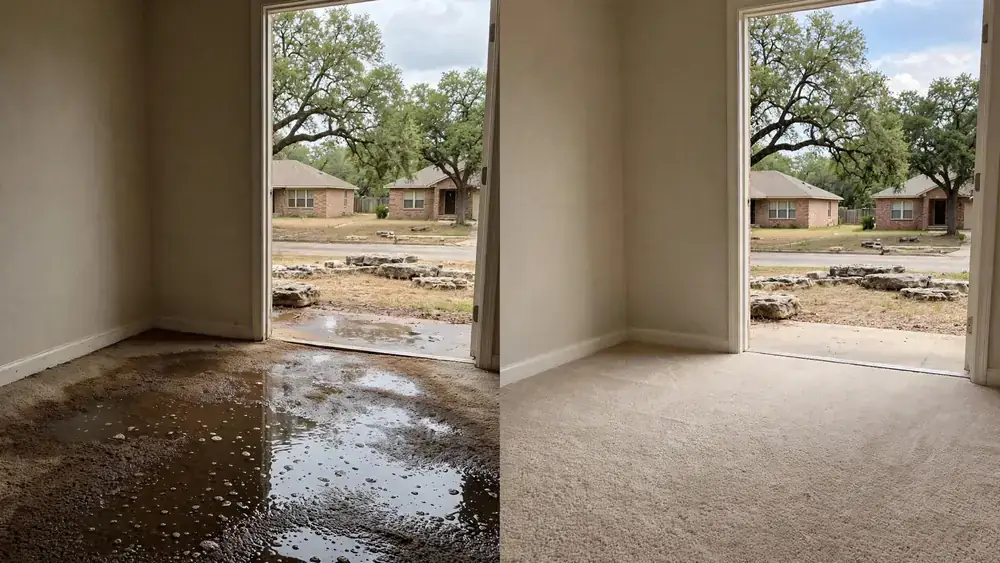
If muddy water does get in, keep clear of it where possible, and treat it as contaminated. Silt in carpets and wall cavities should not simply be dried in place. Move valuables upstairs if it is safe to do so, and take photos before anything is thrown away. The storm and flood cleanup page explains how this work usually proceeds.
Working with the Fairways of Sherrill Park HOA after a leak
- 1
Protect the home first
Stop the water and start drying. Most associations would rather hear about it afterward than hold things up.
- 2
Tell the HOA about shared problems
If water comes from a common area or pathway, report it with photos.
- 3
Ask before changing the outside
A new fence, drain or exterior repair may need review, particularly on the course side.
- 4
Tell neighbors about shared fences
Equipment and repairs can affect side yards, so give them notice.
- 5
Keep a copy of the rules
Ask your association for current rules, as they decide what applies to your lot.
Floors worth protecting in Fairways of Sherrill Park
Bigger homes of this period often have a mix of wood floors, carpet, tile and sometimes stone in entries and kitchens. Each one reacts differently to water. Solid wood can cup as it absorbs moisture and may recover somewhat if dried carefully and slowly. Carpet pad holds water and usually has to go. Stone can stain or darken, and the mortar beneath tile can hold water for days after the surface looks dry.
Rugs, furniture legs and anything with dye can leave marks on wet floors, so lift items onto blocks or foil if you can do so safely. Do not run a household vacuum on wet floors, and take care with rooms where water has reached wiring. Open interior doors to help air move, but keep the air conditioner settings normal unless a contractor suggests otherwise. Water damage in large homes can spread through closets, so check the floors in the rooms around the one you first noticed.
Drying a large open-plan space may take more equipment than a compact room, and the time needed depends on the materials and how long they were wet. The drying time guide describes what can affect it. Ask for moisture readings each day, and keep them with your insurance file.
Slab plumbing and water heaters in Fairways of Sherrill Park
Homes in this area sit on the same moving clay as the rest of Richardson, so a leak under the slab remains a possibility. Plumbing materials changed during the late 1980s and early 1990s, and some homes of that period were built with plastic supply pipes that later gained a poor reputation. If your home has gray flexible pipe, ask a plumber to take a look. There is no need to panic, but it is worth knowing what you have.
Large homes can also have long hot water runs, so recirculating pumps are a common addition. A pump adds fittings and, in some cases, a loop of pipe that runs under the slab or through walls. If a plumber finds a leak in that loop, it may be simpler to isolate it than to repair it. For anything that seems to be under the floor, see the slab leak page.
A two-story home may have its water heaters in the garage or attic. A tank in an attic needs a working pan and drain, and a failure up there is more serious than one at ground level. Check the age of your tanks, and replace them as a planned job. Know where the main shut-off is, and test it once a year. If it is stuck, get it replaced before you need it.
City contacts for Fairways of Sherrill Park owners
If water is surfacing on the street, near a meter or along the edge of the course, report it on the city's 24/7 line at 972-744-4111. The same number takes reports of sewer problems. The city says it maintains the main sewer, and that a stoppage between a city-installed cleanout and the house is the owner's job. Building Inspection takes questions about permits and repairs at 972-744-4180. Keep both numbers in your phone, and share them with anyone who looks after the house while you are traveling.
Golf-course homes are often the ones left empty for a week at a time during travel, and a large house can hide a leak for days. Before you leave, close the main shut-off if nothing needs it, or at least the laundry and ice maker valves. Ask someone to walk through, look at ceilings and listen for running water. If your air conditioner stays on while you are gone, ask a technician whether a float switch is fitted on each system, because that small device can stop a blocked drain from becoming a wet ceiling.
FAQ
Fairways of Sherrill Park water damage questions
Why did my Fairways of Sherrill Park ceiling stain only in summer?
Summer-only stains often come from an air conditioner drain or pan in the attic. Ask a technician to check the line and pan.
Does the Fairways of Sherrill Park HOA fix my leak?
Generally an owner handles problems on their own lot, while the association handles what it maintains. Check your own documents.
Is my Fairways of Sherrill Park home near a floodplain?
It depends on your lot. Spring Creek runs along the course, so check your exact address on FEMA's map service.
Can golf course runoff reach my Fairways of Sherrill Park home?
Water follows grade, so it may if your yard has settled or slopes inward. Watch how water moves during a storm.
Do Fairways of Sherrill Park homes have polybutylene pipe?
Some Texas homes of this period do. Ask a plumber to identify your pipe; only an inspection of your house can answer this.
How can I check my Fairways of Sherrill Park attic safely?
Stay on solid decking with good light, and keep off the insulation between joists. If that is not possible, ask a technician.
Sources and citations
- [1]Richardson TX Real Estate: Fairways of Sherrill Park
- [2]AmateurGolf: Sherrill Park Golf Course
- [3]City of Richardson: 24/7 Response Center
- [4]Regional news report on Richardson drainage study, 2021
- [5]Redfin: Fairways of Sherrill Park
- [6]Listing: 2902 Wembley Ct
- [7]Texas Department of Insurance: Water damage and mold
- [8]FEMA Flood Map Service Center
- [9]City of Richardson: Water utility operations FAQ