Key facts: Owens Park
Pipes reaching middle age across Owens Park
Listing sites describe Owens Park as an established neighborhood of spacious homes from the 1970s and 1980s, with mature trees and Lookout Park at its center. Sample listings on Owens Boulevard show one house built in 1979 and another in 1981, with about 2,000 to 2,600 square feet of living space. Listings also use subdivision names such as Woodcreek and Carriage Square, so your deed may not say Owens Park at all.
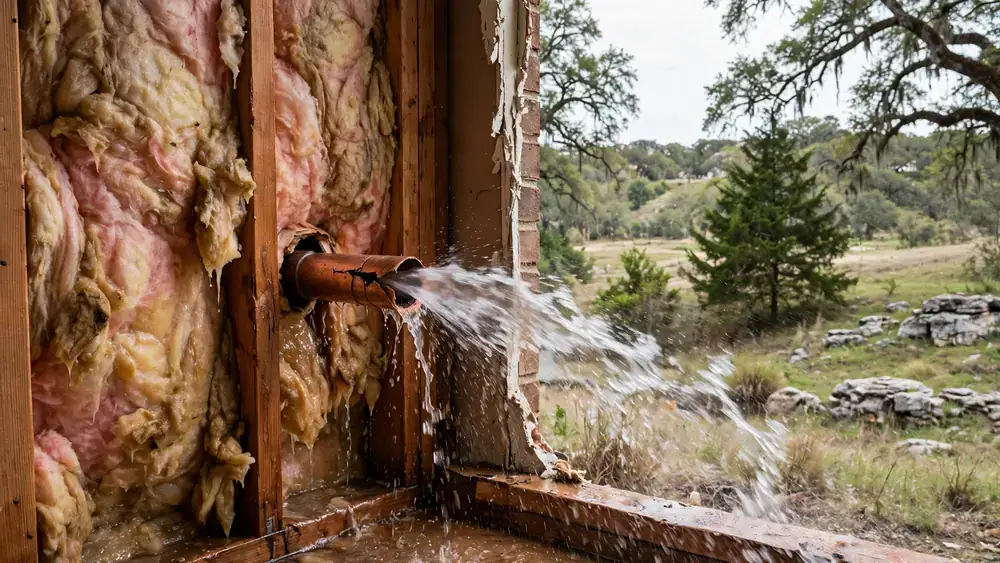
Many homes in this group are now about 45 years old. At that age, parts of the plumbing that nobody has touched are likely close to the end of their service life, unless past owners have replaced them. A burst or a pinhole is seldom bad luck in a house like this. More often it is simply that materials installed at the same time are wearing out at around the same time.
That is why a repair in one spot may not be the end of the story. If you have a failure in an Owens Park home, the most useful next conversation with a plumber is about the remaining pipework, not only the section that gave way. Knowing what you have allows you to plan the work on a calm day, rather than during a flooded morning.
Identifying the supply pipes in an Owens Park house
Houses built around 1980 could have several kinds of water line, and the year alone will not tell you which. Start where a pipe is visible: at the water heater, under a sink, or where the line enters the house. Copper has a reddish-brown color, or a green tint if it has aged. Rigid plastic pipe is usually cream or tan, and it can become brittle in hot areas such as attics. Gray flexible plastic may be polybutylene, which became common from around the late 1970s and later earned a poor reputation for failing at fittings.
If you think you have polybutylene, do not assume a leak is coming, but do ask a licensed plumber to confirm what it is. An insurer may also want to know, and a buyer's inspector will certainly point it out. A [home inspection guide for Richardson](https://inspectandtest.net/guides/home-inspection-richardson/) covers what inspectors tend to look for in local houses.
Avoid over-tightening fittings, and do not disturb old shut-off valves unless you are ready for one to leak. Small stops under sinks may be stiff or seized after decades. A plumber can replace them all in one visit. Do this while you are home and able to watch for drips, and leave the valve in a state you can trust.
If an Owens Park water line lets go
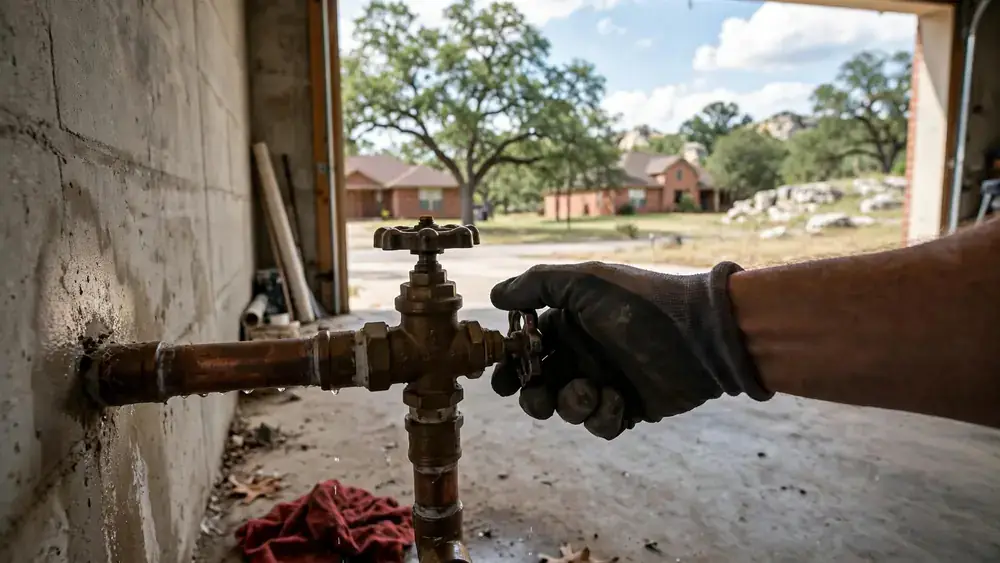
A pipe at full pressure can soak a room in minutes, so the shut-off comes first. Go to the main valve, close it, then open a low faucet to relieve the pressure. If you cannot find or turn the valve, the meter box may offer another way, but check with a plumber first, because the city's equipment should be treated with care.
Once the water is off, turn off power at the breaker to any room with wet outlets, provided you can reach the panel without walking through water. Take photos, then begin moving what you can. Pull furniture away from wet walls and lift curtains off the floor. The burst pipe page describes what usually follows, and the first-hour guide gives a checklist that is easy to keep on your phone.
Rear-entry garages along Owens Park alleys
One listing on Owens Boulevard shows a rear-facing garage with alley access. Not all homes here are built this way, but where the garage sits at the back, the layout has real effects on water. The driveway slab often slopes toward the garage or the alley, and the back of the house may take runoff from a paved surface that was never meant to soak up rain. If a garage door seal has worn out, water can blow or run underneath and reach walls and stored items.
Alleys are also where many utilities tend to run on older Richardson streets. Your sewer cleanout, meter, or other connections may sit close to the alley rather than out front. It is worth walking your lot line to find out, because it is much easier to do so on a dry day. Keep shrubs cut back and do not park or stack anything on a cleanout cap.
Rain carried along an alley can also collect where pavement dips. If a section of alley ponds against your fence after every storm, take a photo and note the date. Pooling on public pavement can be reported to the city, while water that collects inside your lot is yours to manage. Ask a drainage contractor whether your back apron still falls the way it should.
Common Owens Park trouble spots and first checks
| Owens Park location | What may fail | First check |
|---|---|---|
| Hall water heater closet | Tank, relief valve, supply connectors | Rust at the base, damp carpet nearby |
| Rear garage | Door seal, slab joint, floor drain | Stains along the bottom of the wall |
| Original bathroom | Tub drain, toilet flange, valve | Soft floor, loose tile, musty smell |
| Kitchen sink wall | Stops, dishwasher hose, ice maker line | Warped cabinet base |
| Alley-side cleanout | Roots, offset drain joint | Cap access, slow fixtures |
| Yard toward the street | Service line, irrigation | Meter moving with fixtures off |
Owens Park water heater closets
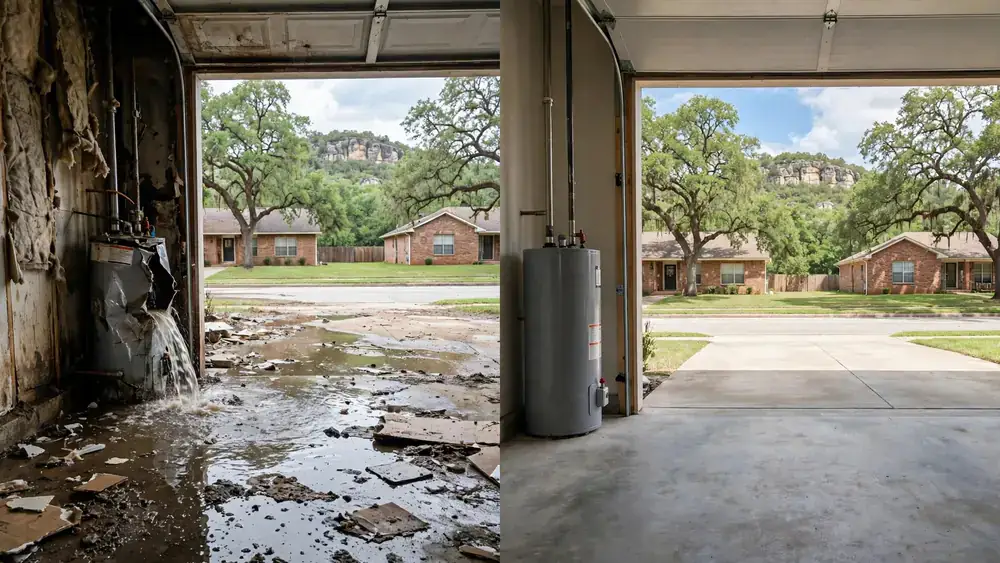
In many homes built around 1980, the water heater sits inside the house in a closet, often near a hallway or utility room. A tank that fails in that spot can wet carpet in more than one room, and a closet leaves water little space except to spread under the walls. Most modern tanks last roughly a decade or so, depending on water and care, so any home this age will have gone through several. The connectors and pan, however, may have stayed in place through each swap.
Look at yours twice a year. Rust at the base, a damp ring on the floor or water dripping from the relief pipe are all reasons to call a plumber. Check the date on the label if you can read it. If it is well past ten years, plan on a replacement and not on repairs, and ask whether a pan and drain line can be fitted. In an interior closet, that question is worth raising every time.
Laundry closets often share a wall with this space. Replace rubber washer hoses with braided ones, make sure the box valves turn, and shut them off before going on a long trip. Small jobs like these do a lot to prevent a long drying process in the middle of the house.
Owens Park bathrooms that were never remodeled
Original bathrooms from around 1980 can still be in daily use, and they tend to reveal their age slowly. A tile tub surround relies on grout and caulk to stay watertight, and once those crack, water can get behind the tile and into the wall. Drywall behind old tile can soften over years. The first visible sign may be a loose tile near the faucet or a bulge at the bottom of the wall.
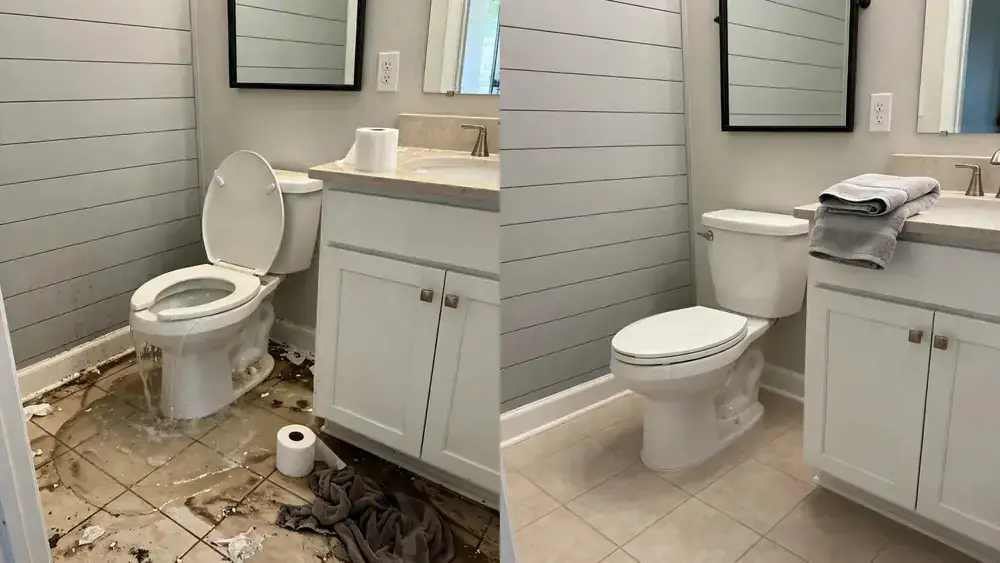
Toilet seals are another slow leak. If the floor around a toilet feels soft or the base rocks, the wax ring may have failed and water may be seeping down each time you flush. On a slab, that water may spread beneath vinyl or carpet in the room next door. Dark staining near the base is worth more than a quick wipe with a cloth.
If you are about to remodel, take the chance to replace what is behind the wall. While the tile is off, a plumber can change old valves and supply stubs. Remember that materials in a home of this age might include asbestos or lead. A home from the late 1970s can sit right at the edge of those concerns, so ask your contractor about testing before old flooring, adhesive or ceiling texture is disturbed.
Sewer lines under mature Owens Park trees
Listing sites mention the mature trees here, and those trees are a big part of the appeal. They also have roots that spread well beyond the canopy and go searching for moisture. Drain pipes from this period may have joints where a small gap can admit fine roots, and these grow slowly until the line begins to back up. The warning signs are gurgling toilets, a tub that drains slowly when the washing machine empties, or more than one fixture running sluggishly at the same time.
The city says it maintains the main sewer, while a stoppage between a city-installed cleanout and the home is the owner's. The sewer stoppage guide sets out how that works in practice. If you are not sure which side the blockage is on, the response line at 972-744-4111 is the number the city gives for sewer problems.
When sewage comes up, stop using water in the house, keep people and pets out of the area, and do not run the washing machine or dishwasher. Dirty water affects soft materials very differently from a clean leak, and carpet and pad usually cannot be saved. See the sewage backup page before you start cleaning. A camera inspection afterward will tell you whether roots or a broken joint were to blame.
An afternoon plumbing survey for an Owens Park home
- 1
Find the main shut-off
Locate it, test it gently, and show everyone in the house.
- 2
Identify your pipe
Look at exposed lines by the heater and under sinks, and take photos.
- 3
Read the water heater label
Write down its date and whether it has a pan.
- 4
Do a meter test
Turn every fixture off and see whether the dial still moves.
- 5
Locate the cleanout
Check near the alley and the front of the lot, and clear plants around it.
- 6
Save it all in one note
Keep the details on your phone so that any contractor can read them.
Foundation movement and slab leaks in Owens Park
A house here has been sitting on shifting clay for over four decades. Dry summers shrink the soil and wet spells swell it, so the slab flexes by small amounts. Pipes buried in or under that slab must live with the movement, and a lifetime of it can open a joint or wear a thin spot. Tree roots drawing moisture from one side of a house may add to the effect.
A hot water line under the floor is a common culprit. You may notice a warm patch of tile, the sound of running water when nothing is on, a sudden rise in your water bill or a musty carpet in one corner. Do a meter test first. Stop all water use and watch the dial for several minutes. If it keeps moving, call a plumber who offers leak detection. The slab leak page explains what they do and how drying follows on from the repair.
Some owners decide to reroute failed lines overhead through the attic rather than break out the floor. That option can suit a house with a straightforward layout, though it has trade-offs in insulation and access, so talk these through with your plumber. Keep records of what was done and when, since a future buyer or insurer may ask.
Storm runoff near Lookout Park and Owens Boulevard
Lookout Park sits at East Lookout Drive and Owens Boulevard, and sources describe about 25 acres of green space, used for soccer and linked to the Owens Trail. Open grass helps to absorb rain, but clay soaks it up slowly, and the surrounding streets and rooftops shed water fast. In a heavy storm, runoff follows curbs and alleys until it finds an inlet. If leaves from those big trees block an inlet, water can back up across a driveway apron.
If your home sits lower than the street or the alley, look for signs of past water: silt lines on a fence, a stained garage wall, or a carpet that was replaced in only one room. Ask neighbors who have been around for years what they have seen. Then check your address on FEMA's map service. A flood map does not cover every local drainage problem, and standard policies usually treat rising water differently from a burst pipe.
Gutters on tree-lined lots fill quickly, so clear them after the leaves fall and again in spring. Extend downspouts so that the water lands well away from the slab, and check that any later patio has not trapped water against the brick. If you see a street or park pipe spilling water in dry weather, tell the city.
Windows and siding on older Owens Park homes
Original windows from around 1980 often have metal frames, and many have since been replaced. Either way, the sealant around them ages. Water that gets past a window or through a gap in upper siding can run down inside a wall without showing, then reach the baseboard or the floor. In a two-story home, this kind of leak can show up as a stain on a lower ceiling, far from the actual gap.
Walk around the house once a year and look at caulking, wood trim and any painted siding. Rotten trim at the bottom of a window is a strong sign that water has been sitting there. Keep paint in good shape and ask a contractor to look at any soft spots. The north and west faces of a house often take the worst of driving rain, depending on how it sits.
If a wall is wet, take a moment before opening it. Remember the possible asbestos concern in textured finishes on homes of this age, and ask for a sample if yours has not been tested. Mold work of 25 contiguous square feet or more needs licensed professionals in Texas, as the mold guide explains.
Permits and paperwork after an Owens Park repair
Repairs in an older house can involve more than one trade, and some of that work may need a city permit. Plumbing that gets moved or replaced, electrical work behind a wet wall and structural repairs are all worth asking about. Ask Building Inspection at 972-744-4180 if you are unsure, and check that any contractor you use is registered with the city. The restoration company guide lists further questions to ask.
Keep a folder for the house with photos, invoices, moisture readings and the name of each company. If you sell, a clear record of repairs helps a buyer understand what was done. If your insurance claim is disputed, those same records are your best support. The insurance guide explains why prompt reporting matters and why a slow leak can be treated differently from a sudden one. For a house of this age, that folder may turn out to be among the most useful things you own, and it takes very little effort to keep up.
If you are new to the neighborhood, ask the previous owner or your inspector which systems have been replaced, and write the answers down. Long-time neighbors on your block can also tell you who has already repiped, which streets have had sewer work, and where water tends to gather in a storm. That kind of local memory fills the gaps in the paperwork.
FAQ
Owens Park water damage questions
Do Owens Park homes have polybutylene pipe?
Some homes of this age may, while others have copper or later repipes. A plumber can check what yours has.
My Owens Park deed says Woodcreek. Does this page still apply?
Yes, if your home is in ZIP 75082 near Owens Boulevard. Listings use several subdivision names here.
Where is the sewer cleanout on an Owens Park lot?
Often near the alley or the front property line. It may be hidden by plants, so look there first.
Why does my Owens Park rear garage get wet in storms?
The apron may slope inward or the door seal may be worn. Watch it in the next storm.
How old is too old for an Owens Park water heater?
Many tanks last around a decade. Look for rust or dampness, and ask a plumber about replacement.
Sources and citations
- [1]Listing: 2218 Owens Blvd, Woodcreek
- [2]TrailLink: Owens Trail
- [3]City of Richardson: 24/7 Response Center
- [4]Rocket Homes: 2314 Owens Blvd
- [5]Homes.com: Owens Park local guide
- [6]City of Richardson: Water utility operations FAQ
- [7]City of Richardson: Residential permit types
- [8]Home inspection guide for Richardson
- [9]TDLR: Mold assessors and remediators FAQ