Key facts: Wyndsor Estates
Wyndsor Estates: big houses from the 1990s
A local real estate guide dates the Wyndsor Estates community to 1991, and it says building continued over the following years. Listings back up that picture, showing many homes from the early and middle 1990s along streets such as Hillingdon Drive, and subdivision names that run through phases, including Wyndsor Estates II, III, IV and Phase V-B. One two-story home on Hillingdon, built in 1993, lists five bedrooms, four full baths and just under 4,000 square feet. Another on Norwood Circle is smaller, at about 2,700. Sizes vary, so read these as examples and not as a rule.
The scale of these homes is what shapes water damage here. A long house with two floors has long pipe runs, several full baths, often two air systems, and wet rooms sitting above kitchens, studies and formal living spaces. The materials are good but they are now thirty years old, and that is when many original parts begin to reach the end of their service. When something fails, more finished surface lies in the path of the water, so finding and stopping it quickly matters more than it would in a compact single-story ranch.

Upstairs bathrooms over Wyndsor Estates kitchens
Water from a second-floor bathroom has a long way to go before it stops. Think about a tub overflow, or a toilet supply that bursts while everyone is out. It soaks the bath mat, passes through tile grout or vinyl, wets the subfloor, runs along joists and comes through a ceiling, often at a light fixture. If you see water dripping from a can light, turn that circuit off at the panel if you can do so from a dry spot, and keep away from the area below.
Slow leaks are in some ways worse. A shower pan that has begun to seep, grout that has opened at the curb, or a wax ring that has stopped sealing can feed a little water for months. The stain below appears gradually, and it may be blamed on the air conditioner or the roof. If you see a stain, ask what is directly above it. Run each fixture in turn and look at the ceiling afterward. Run the shower with the drain open, then plug the tub and let it stand, because the two tests separate supply, drain and pan problems. A plumber can do this properly, but simple observation narrows things down.
What pipe is inside a Wyndsor Estates wall?
Water supply materials changed through the early 1990s, and it is worth learning what your home has. Many homes of that period used copper. Some built in those years used gray polybutylene tubing, which saw wide use until the mid-1990s and developed a reputation for failing at fittings. Your house may have neither, and it may have been repiped already, but you should not guess. A plumber can check by looking where the line reaches the water heater, under sinks and at the main shut-off. Stamped markings on the pipe often tell the story.
If you do find polybutylene, take it as useful information instead of a crisis. Some insurers ask about it, so tell your agent what you have and how your policy treats it. Plan a repipe when it suits you, perhaps during a remodel with walls already open. If it is copper, look for green crust at joints in the attic or at the heater, since that can show slow weeping. Whatever the material, a burst pipe in a house this size can run through a large area, so a whole-house shut-off you can reach and operate is the most important fitting you own.
Where to look in a two-story Wyndsor Estates home
| Source | What it reaches | Early sign |
|---|---|---|
| Wyndsor Estates master bath shower pan | Ceiling and walls of the room below | Slowly growing ceiling ring |
| Upstairs attic air handler | Bedroom ceilings on the top floor | AC cuts out, stain near a vent |
| Original 1990s water heater location | Closet walls or the garage floor | Rust at the base, damp drywall |
| Kitchen island or ice maker line | Hardwood, cabinets, nearby rooms | Cupping in floorboards |
| Roof valley above a two-story wall | Upper wall, window head, lower room | Stain after wind-driven rain |
Two air systems above Wyndsor Estates ceilings
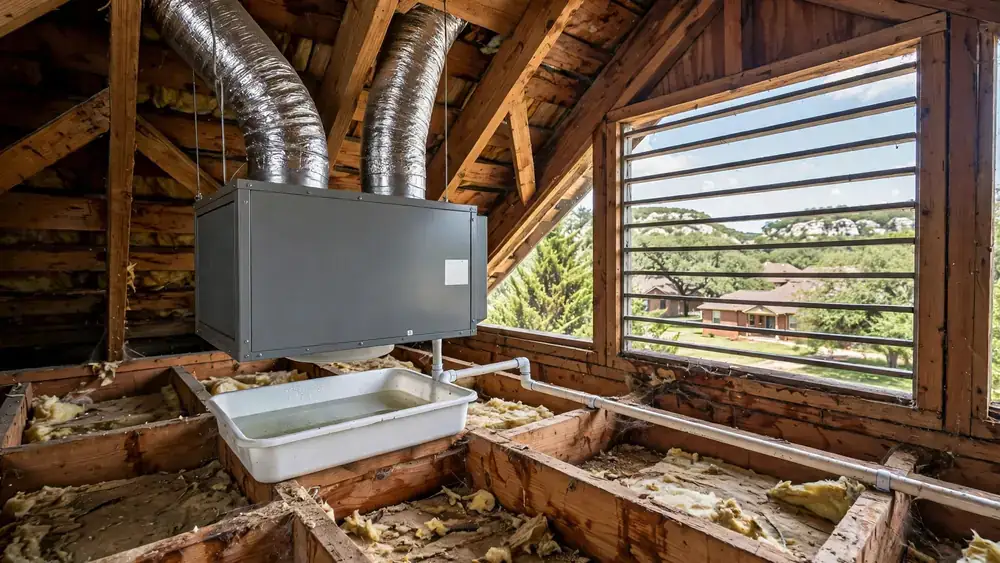
A home of this size often has more than one air conditioning system, frequently with at least one in the attic, serving the upper floor. Every one of them makes condensate, and each drain line can clog on its own. On a hot, humid day an air handler can produce several gallons. If the primary drain backs up, the overflow pan is the last defense, and after thirty years of attic heat a galvanized pan may be rusted through. A homeowner who has replaced the system may also have kept the old pan, so look at it even when the unit is recent.
Check the pan each spring with a flashlight, if you can reach it from the decking. Ask your HVAC contractor to confirm that a float switch is fitted and working on each system. Flush the lines before cooling season starts. Keep the auxiliary outlet in mind too: if you see water coming from a small pipe at the eave, the main line is already blocked. The AC leak page sets out how these failures present. Attic insulation above a wet ceiling tends to stay damp, so do not judge a repair by how the painted surface looks.
Roofs and tall walls on Wyndsor Estates streets
Complex roofs with several gables and valleys came with this style of house. They look handsome, and they also have more places where water is concentrated. Valleys carry a large amount of runoff, and any place where a lower roof meets a two-story wall depends on step flashing to shed water properly. On a house from the 1990s, the roof has probably been replaced at least once, particularly after North Texas hail seasons. A new roof is only as good as the flashing that went back with it, so ask to see photos if you are having one installed.
Tall walls also take more wind-driven rain than a low ranch does. Brick veneer is not waterproof; it relies on the cavity behind it, the weather barrier and weep holes to let water out. Check that landscaping and mulch have not buried those weeps. Look around upper windows for failed sealant. If a stain appears below a window only in certain storms, write down the direction of the wind. A roofer or a masonry contractor can use that note. Gutters on a two-story house are harder to reach, so hire someone to clear them rather than working from a ladder.
Winter freezes and exterior walls in Wyndsor Estates
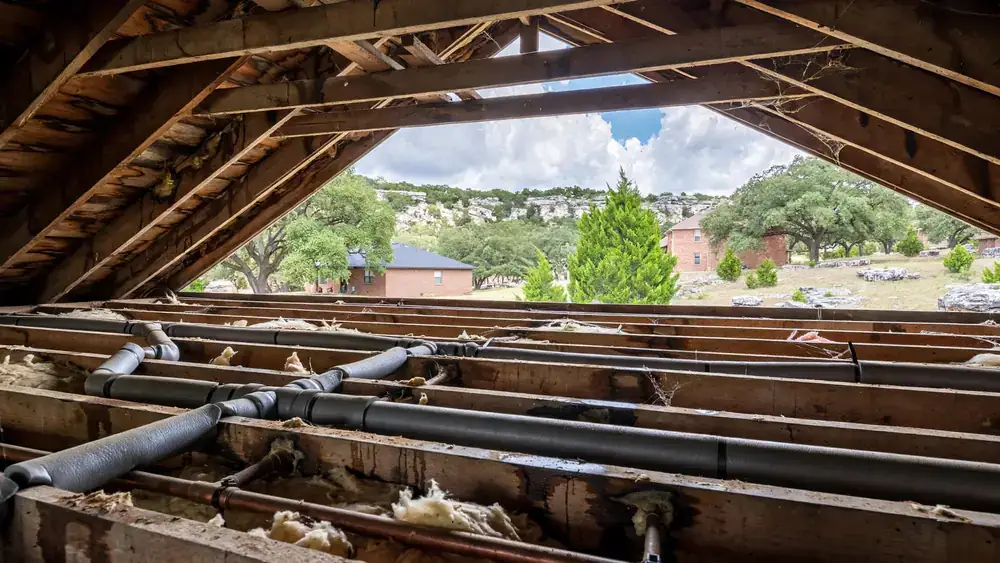
Hard freezes are not common here, but when they arrive, large houses have more vulnerable points: pipes in attics, lines in unheated garage walls, and hose bibs on exposed sides. Bonus rooms over garages can be especially cold. Before a freeze, disconnect hoses, cover outside faucets, open the cabinet doors under sinks on outside walls, and let a slight drip run if a line has a known weak spot. If you plan to go away during cold weather, leave the heat on and shut off the main water.
Remember that a split pipe tends to reveal itself when things thaw, not at the moment it freezes. If a faucet stops working during a hard freeze, assume a section of line is frozen and know exactly where the shut-off is before it warms up. Keep a shutoff key if your valve needs one. With two floors, a leak in an attic line can reach both levels, so have someone stay near the shut-off while the system comes back on. The first-hour guide gives a clear order of action if a line does fail.
Handling a second-floor leak in Wyndsor Estates
- 1
Close the main
In a house with long runs, the main is usually quicker and surer than searching for a local valve.
- 2
Check below
Go downstairs to see where water has reached, and stay clear of any sagging ceiling.
- 3
Kill wet circuits
If water is coming through a light fixture, turn the breaker off from a dry place.
- 4
Move what matters
Lift rugs and furniture off wet hardwood, and put foil or blocks under the legs of anything that must stay.
- 5
Bring in the trades
Call a plumber for the failure, then an independent drying contractor to map moisture on both floors.
Hardwood, stairs and formal rooms in Wyndsor Estates
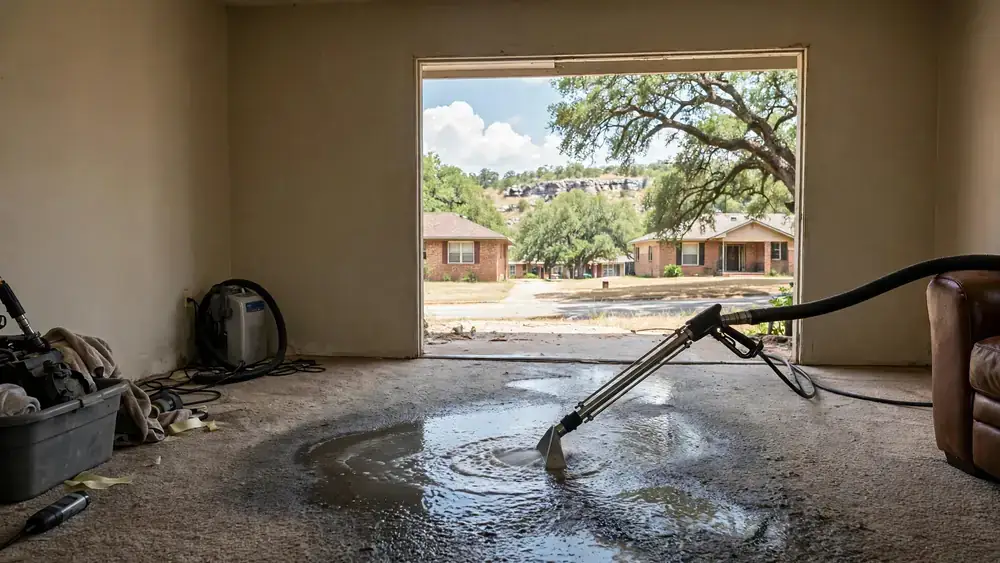
Large 1990s homes often have a mix of finishes: hardwood in the entry and dining room, carpet on the stairs, tile in baths, sometimes wood-paneled studies and built-in shelving. Each behaves differently when wet. Hardwood can cup as moisture rises from below, and it may recover to some degree if dried early and carefully. Carpet can sometimes be saved if the water is clean and pad is replaced. Built-ins are fragile, since their backs often trap moisture against the drywall and their bases may be made of particleboard.
Staircases deserve a special mention. Water that gets into a stair stringer or the closet under a staircase can be hard to reach and easy to overlook. Ask whoever is drying the house how they plan to check these spots. You might also ask about extraction and drying with mats for hardwood, which draw water from beneath the boards. Take photos of the finishes before any demolition, including the pattern of tile or the stain on the boards, because a matching repair is much easier when the original can be seen in the record.
The Wyndsor Estates HOA and exterior repairs
The City of Richardson marks Wyndsor Estates as a mandatory association on its homeowner association list, and at least one listing notes a mandatory association and a yearly assessment. In a neighborhood with detached houses, the association usually concerns itself with common areas and deed restrictions, while the house and its repairs remain the owner's job. Even so, the rules can apply to what you do after a loss. A replacement roof color, a new fence, a changed exterior door or a visible repair may need approval through an architectural process.
If a storm has damaged several homes, ask the association for guidance before work starts. A roof replaced with the wrong shingle may need redoing. Make the request in writing and keep the reply. Ask too if any drainage easement runs behind your lot, because fences or planting beds placed across one may push water toward a neighbor or toward your own wall. For the interior, it is your insurer rather than the association that matters. Permits come from the city, so check with Building Inspection at 972-744-4180 before major rebuilding starts.
Pools, irrigation and yard drains around Wyndsor Estates
Lots at this end of town are often large enough for a pool, an irrigation system or both, and listings for individual homes sometimes show pools. Each adds pressurized lines, plus a chance of water being where it should not be. An irrigation backflow device or a cracked lateral can leak for weeks, showing up only as a very green patch or a soft spot of lawn. A pool leak may not be visible at all, while a pool deck poured toward the house will push rain straight at the slab during storms. Note that a backyard yard drain can clog with mulch or leaves and quietly stop working.
During a rainstorm, step out and look at what your own lot does. Check that downspouts discharge beyond any flower bed. Confirm that patio slopes lead away from the door. Run the sprinklers for each zone once a season and walk them, looking for heads that hit the wall. Then read the water meter overnight, with everything off, because a moving meter can point to a line outside the house just as easily as a leak inside. Use the FEMA Flood Map Service Center to check your address, as the map only tells part of the story on a given street.
Sewer lines and the many bathrooms of Wyndsor Estates
A home with four or five baths has plenty of drains feeding one building sewer. A stoppage typically shows at the lowest fixture first, such as a ground-floor shower or powder room, even though the cause may be well outside the house. When toilets upstairs make a downstairs tub rise, stop using water right away. Then find the cleanout, often near the front of the lot or along the property line. Richardson's stated rule is that it maintains the main sewer, and an owner is responsible for a stoppage between a city-installed cleanout and the house.
If you see overflow at the cleanout itself, or sewage in the street, report it to the city at 972-744-4111. If the cleanout is clear, call a plumber. Any sewage on a floor is contaminated, and the sewage backup page shows how porous materials are normally treated. Big trees planted in the 1990s now have sizable root systems, so a camera inspection of the line is worth considering if you get repeat slow drains. Do this while it is a nuisance, not after a backup has reached a finished ground-floor room.
Insurance and paperwork for Wyndsor Estates owners
Texas Department of Insurance guidance separates sudden accidental water damage from slow, ongoing leaks, and it treats outside flooding as a matter for separate coverage. In a large home, a slow leak can be the most contentious, because it often runs out of sight for months. Keep records that show you maintained things: dated service invoices for the air systems, plumbing work and the roof. If you suspect a problem, report it and act, since a policy usually expects you to stop further harm once you know about it.
Make an inventory before you need one. Walk the house with a phone, filming each room, with cupboards and closets open. Large homes have more contents than people remember, and it is hard to reconstruct a formal dining room or a home office from memory. Save the video in the cloud. During a claim, keep a log of calls, get scope documents in writing and understand what you sign. The choosing a company guide lists questions for any contractor, and the city requires contractors to be registered, so asking for that detail is entirely normal.
Why Wyndsor Estates phases can differ house to house
Since Wyndsor Estates was recorded in phases over a number of years, two houses a few streets apart may not share the same age, plan or plumbing choices. Listings show Phase I addresses on New Castle Drive, phase II and IV addresses along Hillingdon, and a much larger home on Peck Place reported at more than 5,700 square feet. A fix that suited a neighbor on Faversham may not suit your house on Norwood Circle, so treat advice from the street as a useful starting point and nothing more.
Find your phase on your deed or tax statement and note the year built. Then ask direct questions of the neighbors who bought in the same phase: has anyone repiped, had a shower pan rebuilt or replaced a particular fitting? A shared builder or plumbing crew can mean a shared weakness, and a pattern among several similar houses is worth raising with your plumber. Write down what you learn, and keep the note with your house records for whoever owns the home next.
FAQ
Wyndsor Estates homeowner questions
How old are homes in Wyndsor Estates?
A local guide dates the community to 1991, and listings show many early to mid-1990s homes. Check your own record for the exact year.
Could my Wyndsor Estates home have polybutylene pipe?
It is possible for homes of that period. Ask a plumber to check at the water heater and under the sinks.
Is Wyndsor Estates the same as Wyndsor Court?
They are neighbors, but the city lists separate associations, and listings show Wyndsor Court homes as newer. Check your deed.
Why is my Wyndsor Estates upstairs ceiling wet when the AC is running?
A blocked condensate line or a failed pan is a likely cause. Turn the system off and look at the attic pan.
Do I need Wyndsor Estates HOA approval for repairs?
Interior repairs usually do not, but exterior changes may. Read your deed restrictions and ask in writing.
Who handles a sewer stoppage at my Wyndsor Estates home?
The city maintains the main. A stoppage between a city-installed cleanout and the house belongs to the owner.
Sources and citations
- [1]Dustin Pitts: Best neighborhoods in Richardson TX
- [2]City of Richardson: Homeowner associations
- [3]City of Richardson: 24/7 Response Center
- [4]Listing: 3041 Hillingdon Drive
- [5]Listing: 5701 Abingdon Drive
- [6]Listing: 3415 Norwood Circle
- [7]Compass: Wyndsor Estates homes
- [8]City of Richardson: Water utility operations FAQ
- [9]Texas Department of Insurance: Water damage and mold coverage
- [10]EPA: A brief guide to mold, moisture and your home