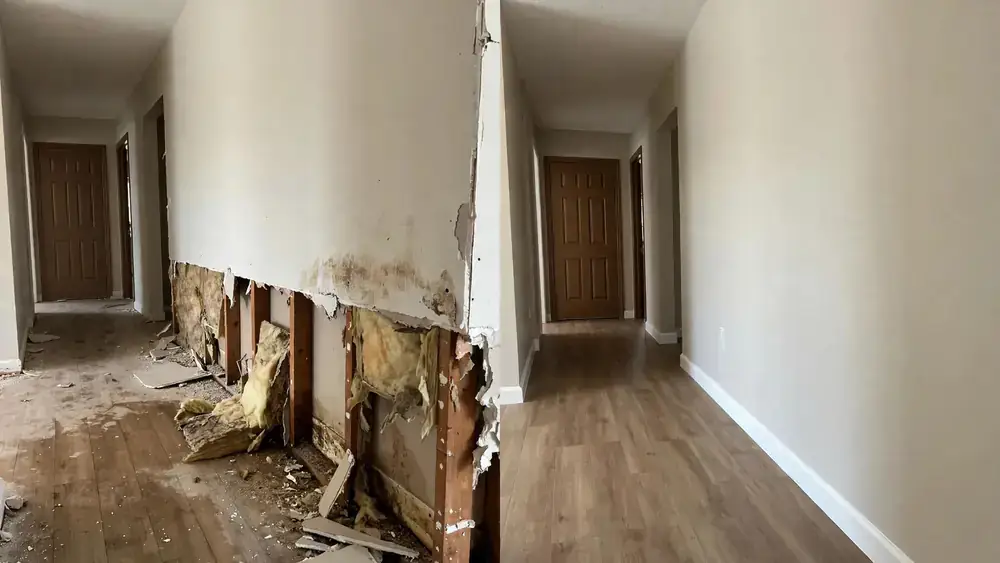
Key facts: Richland Meadows
Why Richland Meadows leaks often begin overhead
Much of Richardson's housing talk is about 1960s ranches, but Richland Meadows does not really fit that story. One neighborhood profile dates the community to about 1995 and describes mostly large homes. A pending listing on Lahinch Circle showed five bedrooms, four baths and roughly 4,200 square feet, which gives a sense of the scale at the upper end. Not every house here is that size, so treat this as a picture of the neighborhood and check your own records.
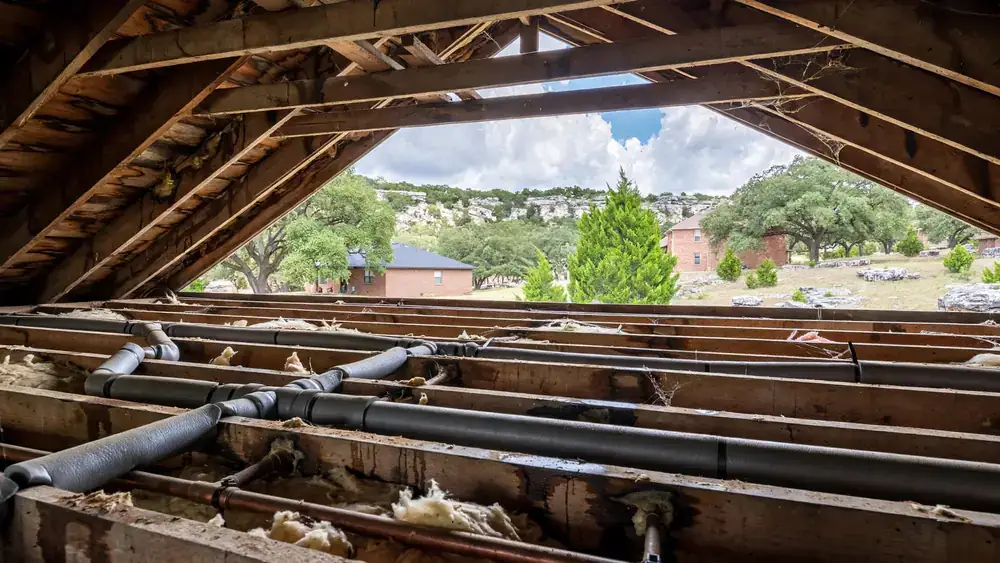
Size changes how water damage behaves. A one-story ranch usually has its plumbing in the slab, and the first warning comes through a floor. A larger home, particularly one with a second story, often has supply lines, drains and sometimes a washer above finished ceilings. When something fails up there, gravity does the rest. Water runs along joists, follows a pipe or a wire, and drops out at a light fixture or a seam in the drywall that may be two rooms away from the actual problem.
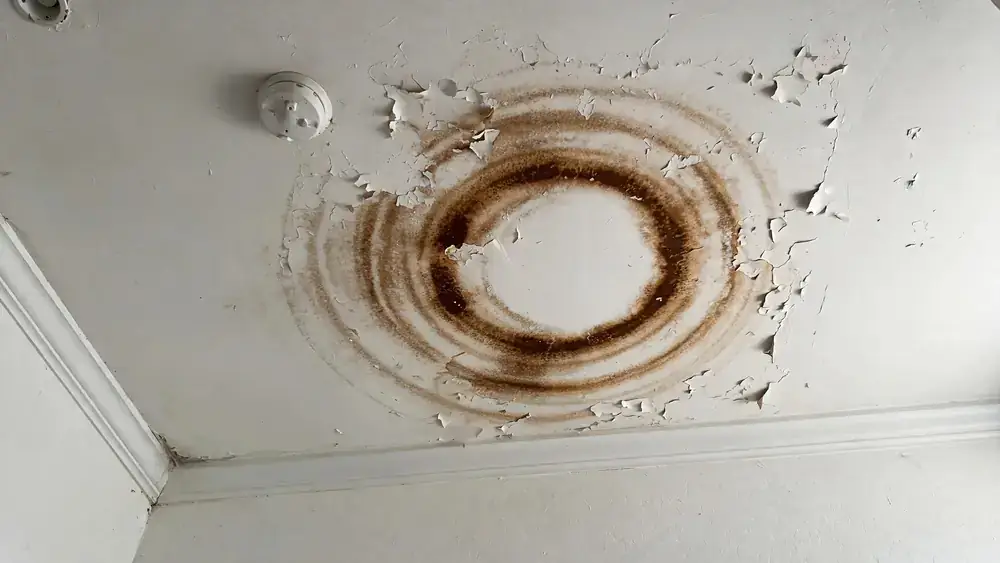
That is why this page leads with ceilings. A stain below an upstairs bath is the easy case. The harder case is a damp patch in a dining room that sits under a hallway, with the true fault in a shower pan or a drain joint further along the framing. Before anyone cuts drywall, a thermal camera and a moisture meter can help show the path, and that keeps the opening small and in the right place.
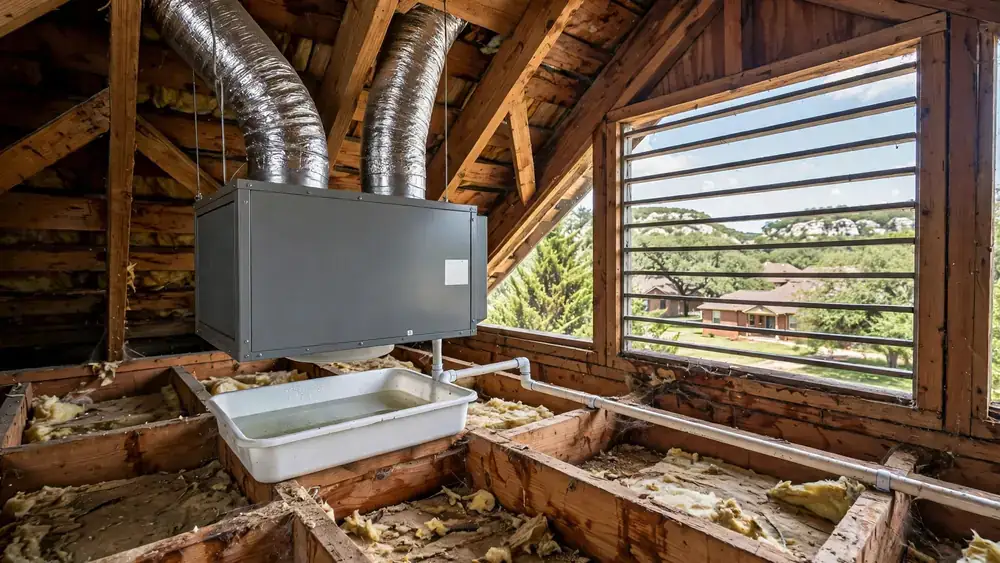
Attic air handlers above Richland Meadows bedrooms
Homes of this age and size often carry at least one air handler in the attic, and a big floor plan may have two systems. During a Richardson summer, those units pull a lot of water out of indoor air, and that condensate must leave through a small drain line. If algae or debris blocks the line, the water backs up into the pan. A float switch, where fitted, should shut the system off. If there is no switch, or it has failed, the pan can overflow onto the ceiling below.
A stain that shows up in hot weather and grows while the air conditioning runs points toward this cause, though it does not prove it. Look in the attic if you can do so safely, stepping only on framing or decking. A rusty pan, standing water or a wet patch of insulation are useful things to photograph. The AC leak and ceiling damage page explains what usually happens next, including why wet insulation is generally removed and not left in place to dry.
- Check the pan at the start of each summer
- Ask the HVAC contractor to confirm a float switch
- Know how many systems your house has
Matching a Richland Meadows symptom to a likely source
| What you notice | Possible source | First place to look |
|---|---|---|
| Stain grows when the AC runs | Blocked condensate line above that room | Attic pan and float switch |
| Drip after someone showers upstairs | Shower pan, tile joint or drain connection | Ceiling directly under the upstairs bath |
| Wet baseboard beside an upstairs laundry | Washer hose, drain box or overflowing standpipe | Behind the washer, then the room below |
| Stain appears only after wind and rain | Roof valley, flashing or window head | Attic side of the same ceiling area |
| Warm spot on a downstairs hard floor | Pressurized hot line under the slab | Water meter dial with all fixtures off |
Second-floor laundry rooms in bigger Richland Meadows plans
If your home has its washer upstairs, that one appliance can do more harm than almost anything else in the house. Rubber fill hoses age out of sight, and a hose failure keeps pouring until someone turns the valve off. A pan under the machine helps with slow drips, and a pan with a drain line helps more, but neither can keep up with a fully open hose. Braided hoses and a single-lever shut-off behind the machine are simple upgrades to ask a plumber about.
Make a habit of checking the wall box and the area behind the machine a few times a year. It takes a minute with a flashlight. If you leave for a trip, turning off the washer valves is a small step, and shutting the main is a stronger one. A long weekend is exactly when a small failure upstairs becomes wet drywall on two floors. Since a large house can hide a slow leak for weeks, check the ceiling below the laundry as well, not just the laundry itself.
First steps for a Richland Meadows ceiling leak
Do what is safe, in this order, before the plumber or restoration contractor gets there.
- 1
Stop the water
Close the fixture valve if you know the source, or the main shut-off if you do not.
- 2
Keep clear of sagging drywall
A bulging ceiling may hold water. Stay out from under it and move what you can.
- 3
Turn off power to wet fixtures
Use the breaker if water is near a ceiling light, and only if the panel area is dry.
- 4
Photograph both floors
Capture the stain, the room above and any attic pan before anything changes.
- 5
Note the timing
Write down whether it started with the AC, a shower, the washer or rain.
Pipe materials in mid-1990s Richland Meadows houses
A house built around 1995 sits in an interesting spot for plumbing. It is too new for the galvanized lines you find in older parts of Richardson, yet it is old enough that its first set of hidden parts may now be around 30 years old. Depending on the builder and the year, supply lines might be copper or a plastic product. Some homes from the period may have polybutylene, a gray plastic pipe that fell out of favor in the 1990s after failures at its fittings. That does not mean yours has it, and a plumber can tell you quickly by looking at exposed lines at the water heater or under a sink.
Copper in a house of this age can also develop pinholes, which begin as tiny sprays inside a wall. They tend to show as a slowly spreading damp patch and not as a sudden flood. Whatever you have, knowing it is useful. Tell a contractor what you know when you call, and if the home was repiped, keep that paperwork with your insurance file. If a line has already split, the burst pipe page walks through the usual order of work.
Drying the big rooms of Richland Meadows
Large rooms and tall ceilings change how a dry-out runs. A two-story entry or a family room with a high ceiling holds a great deal of air, and equipment has to be sized to that volume. An open plan also means wet air moves around freely, so a contractor may need to section off an area with plastic sheeting to get the drying rate up. If only one ceiling is wet, containment can keep the rest of the house comfortable and stop the equipment from working against the whole floor plan.
Layers matter too. Water that passes through a subfloor can sit between the upstairs carpet pad and the downstairs ceiling, in a cavity that no fan will reach from outside. A good contractor will measure moisture in the cavity, not only on the painted surface, and may open a small section to let air in. Ask to see the readings each day. Drying goals are set from dry parts of the same house, and you should be able to see that comparison. The drying time guide gives a fuller picture of what affects the schedule.
Roof and window leaks on Richland Meadows two-story walls
Not every wet ceiling is a plumbing problem. Bigger homes tend to have more complicated roofs, with valleys, dormers and places where a lower roof meets an upper wall. Each of those joints depends on flashing, and hail or a hard wind-driven rain may find a weak point. Even a replaced roof does not rule this out, since flashing and sealant details vary by house. The same goes for tall windows, where rain can get in above the head of the frame and run down inside the wall.
The tell is timing. If a stain only grows during storms from one direction, tell the roofer. Take a photo of the ceiling with a date and a coin for scale, then compare it after the next rain. Keep in mind that water can travel along a rafter before it drops, so the leak on the roof may not sit straight above the stain. For more on storm losses, including what to do when water arrives from outside at floor level, see storm and flood cleanup.
Pools, irrigation and the Richland Meadows yard
A larger lot usually comes with more outdoor water use. Sprinkler zones, hose bibs and, on some lots, a pool all add pipe and valves. A broken irrigation line tends to show as a soggy strip of lawn or a sudden jump on your water bill, and a zone aimed at the house can keep the slab edge and the brick wet for hours. Walk each sprinkler zone a couple of times a year while it runs, and turn heads away from the wall. Wet brick at the base of a wall after a dry week is worth a closer look.
North Texas clay also moves with moisture, swelling when wet and shrinking in drought. Keeping moisture even around the foundation is a common recommendation, while extremes on one side of the house add stress. Even a home from the 1990s can see this, and it can show as sticking doors or cracks at corners. If you see those signs along with a moisture problem, ask a plumber to check for a leak before assuming the two are unrelated. The meter test in the slab leak guide is a useful place to begin.
Claims and paperwork for a Richland Meadows loss
One listing recorded no association for a home in this subdivision, and that is worth confirming for your address, because it changes who you need to talk to. If no association applies, then everything inside your lot is simply between you, your insurer and your contractors. If you are unsure, check your closing papers. Mold or a long-running leak can raise harder coverage questions, and the Texas Department of Insurance has plain guidance on when water damage and mold are covered. Read your policy, since wording differs.
Sudden events and slow leaks are often treated differently, so note what you saw and when. Dated photos, a plumber's written finding and a saved piece of the failed part all help. Do not throw away a split hose or a cracked fitting until your adjuster says you can. For more detail, read the guide to Texas homeowners insurance and water damage. If you spot mold, the EPA advises fixing the moisture source first, and Texas has licensing rules for larger areas, covered in the mold rules guide.
Upstairs bathrooms in Richland Meadows homes
Showers are the most common slow leak on an upper floor. A tile shower depends on a waterproof pan below the tile, and that pan is out of sight from the day it is installed. After 25 or 30 years, a corner can open up, a drain connection can loosen, or grout and caulk can let water behind the surround. You might see nothing upstairs at all. The only clue may be a faint ring on the ceiling below, one that darkens a little after each shower and fades in between.
A simple test can help. With the shower off, run the sink and flush the toilet, then look at the ceiling below. Next, run water only on the shower walls, then only into the drain, and finally plug the drain and let a little water stand on the floor of the shower for a few minutes. Watching which step brings on a drip tells a plumber a lot. Tubs have their own weak points, mainly at the overflow plate and the drain shoe. Those parts tend to leak only when a bath is filled high, so a stain linked to bath time points right at them.
Finished materials common in larger Richland Meadows homes
A bigger house often comes with more wood floors, more built-in cabinets and more trim, and these respond to water in their own way. Solid hardwood can cup as moisture moves up from below, and it may take weeks to show its final shape. Stopping early, or sanding too soon, can lead to a second round of work. A contractor should measure the wood and the subfloor and should let you know what can be dried in place. Thick engineered floors may behave differently, so ask which you have.
Built-ins deserve attention as well. Water that runs across a floor can sit behind a kitchen toe kick or under a bookcase where no fan reaches. Removing a toe kick is a small job, and it allows drying air under the cabinets. Crown molding and tall baseboards hide gaps where damp air may linger too. If your home has a finished room above the garage, check the floor there after any leak, since it may be built differently from the rest of the house and can be colder, which slows drying.
When a Richland Meadows home sits empty
Larger homes often have fewer people in them for parts of the day, and rooms that rarely get used can hide a problem for a long time. A guest bath that nobody runs can lose the water in its trap, and a toilet supply that drips sits unnoticed. Walk through unused rooms every week or so. Flush the toilets, run the taps for a moment and glance at the ceilings. This is a dull habit, but it catches slow leaks at the stage when they are still easy to fix.
For longer trips, shut the main valve and leave the water heater on its vacation setting if it has one. A small water sensor placed under each upstairs sink, behind the washer and by the water heater is quick to set up, and some can close a valve by themselves. Ask a neighbor or relative to look in while you are gone and show them where the main is. If you return to a wet house, stop the water first, take your pictures, and then read the first-hour guide before moving furniture.
Richland Meadows plats and phased building
Listings file some homes here under a replatted first phase, which suggests the community was built in stages. Neighboring houses may therefore differ in age, builder and plumbing, and a large home on Lahinch Circle may not share the same details as one a few streets away. When you compare notes with a neighbor, ask what year their house was finished. Then check your own appraisal record, because a useful warning about one phase may not apply to yours.
Twice-yearly walk-through for a Richland Meadows home
- Look at every attic pan and listen for the float switch
- Run a hand along upstairs baseboards near baths
- Check ceilings under showers with a flashlight held flat
- Inspect washer hoses and the wall box
- Read the water meter with everything off
- Test that the main shut-off actually turns
City contacts and who handles what near Richland Meadows
Most losses in a house of this kind start inside, so the first call often goes to a plumber. Still, keep the city numbers handy. If water is coming up in the street or at the meter box, or if you have a sewer problem you think is on the public side, the city's 24/7 line is 972-744-4111. The city maintains the main sewer. If a stoppage is between a city-installed cleanout and the house, that part is the owner's. If your repairs need a permit, Building Inspection is at 972-744-4180.
When you call this site's number, you are connected with an independent contractor who does the work. It helps to say Richland Meadows, which floor is affected, whether the water has been stopped, and whether anything looks like it might be sewage. The first-hour guide is a handy page to save now, because a calm house is the best time to find the main valve and make sure each adult at home knows where it is.
FAQ
Richland Meadows water damage questions
Why is my Richland Meadows ceiling wet when no pipe runs above it?
Water travels along framing, so the source may be a room or more away. An AC pan, a shower drain or a roof joint are common places to check.
How old are homes in Richland Meadows?
A neighborhood profile dates the community to about 1995. Check your own deed or appraisal record for the exact year.
Should I poke a hole in a bulging Richland Meadows ceiling?
It is safer to stay clear, cut power to nearby fixtures and let a professional handle it, since a wet ceiling can fall without warning.
Do Richland Meadows homes have an HOA that handles leaks?
One listing recorded no association, but this may differ by plat. Your closing papers will confirm what applies to your address.
Can wet insulation in my Richland Meadows attic be left to dry?
Soaked insulation often needs removing, because it holds moisture against the ceiling below. Ask your contractor to show you the readings.
Sources and citations
- [1]Neighborhoods.com: Richland Meadows
- [2]Knox Realtors: Richland Meadows Ph 01 Rep
- [3]City of Richardson: 24/7 Response Center
- [4]City of Richardson: Water utility operations FAQ
- [5]City of Richardson: Residential permit types
- [6]Texas Department of Insurance: Water damage and mold coverage
- [7]EPA: A brief guide to mold, moisture and your home
- [8]Redfin: Richland Meadows