Key facts: Yale Park
How rain becomes the first Yale Park concern
One local guide describes the Yale neighborhood as mostly ranch-style homes on tree-lined streets, with the park at its center offering paths and sports courts. Address data for Yale Boulevard shows homes mostly from the 1970s through the 1990s, often around 1,700 to 2,300 square feet with three or four bedrooms. That layout says something about water. A one-story slab house has its finished floor only a short step above the yard, and rooms spread across a wide footprint, with a lot of outside wall exposed at ground level.
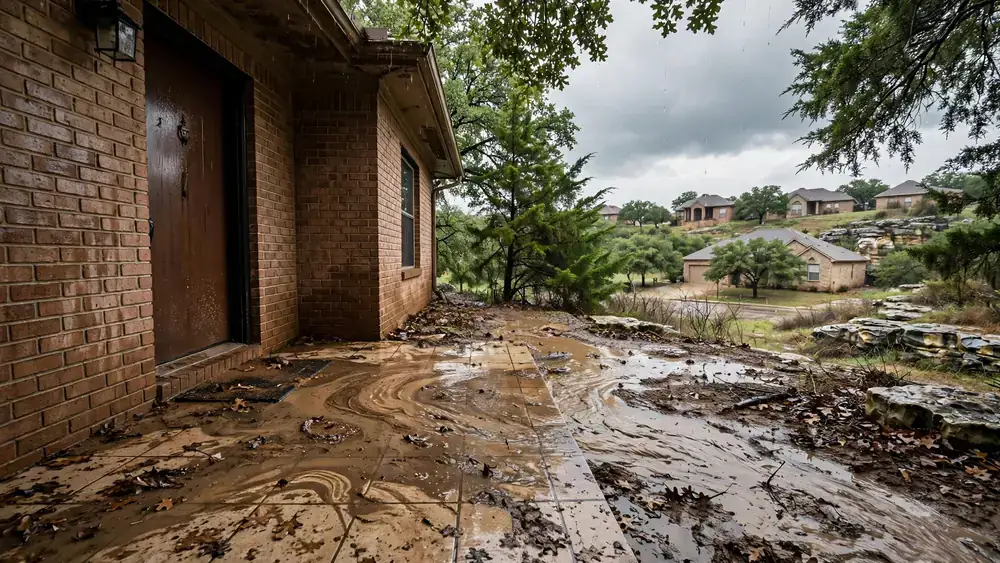
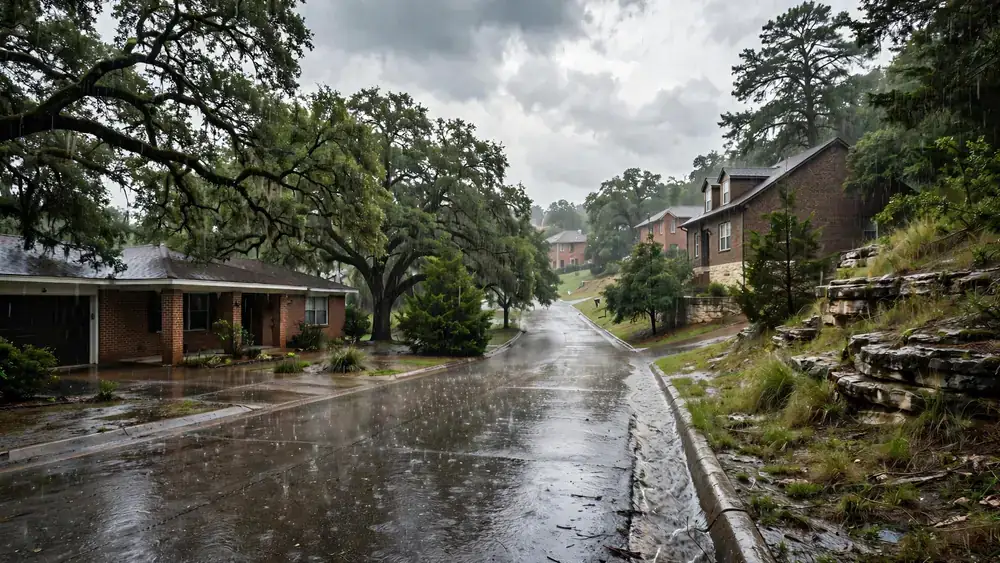
Nothing here suggests that Yale Park is unusually prone to flooding, and no specific event turned up for any street. The point is simply that homes of this type take water from the outside in a predictable way. When a hard Texas storm drops more rain than gutters and yards can move, it goes to the lowest easy path, which may be a door sill, a garage slab or the joint between a patio and the house. A few inches of water at the wrong place can wet carpet and the bottom of the drywall throughout a room.
So this page puts the outside of the house first. The inside problems common to any home in Richardson, such as slab leaks and backed-up drains, still apply, and links below point to those pages. But if you live near the park or the trail and want to know what to look at this weekend, start with your gutters, the grading along the walls and the way the driveway slopes.
Yale Park gutters and tree-lined streets
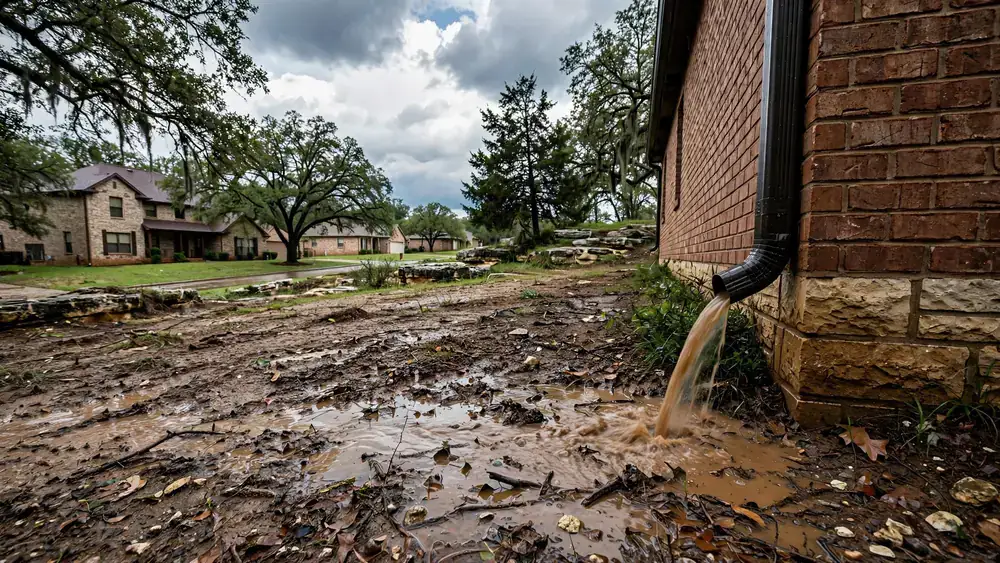
Tree-lined streets are a large part of the appeal, and they are also what clogs gutters. A ranch roof has long, low eaves and often a valley or two where sections meet. When leaves pile up there, the first heavy rain goes over the edge and lands right beside the slab. On a house with no gutters at all, the water drips along the whole length of the eave and can cut a small trench in the soil. Over the years that erodes the slope that once took water away from the wall.
Clean the gutters after the leaves fall and again in spring, and make sure each downspout empties several feet from the foundation. Splash blocks or extensions take minutes to fit. Watch the system in action during a steady rain, since this is the one time you can see where the water really goes. Take a short video. If a corner pools or a downspout backs up, you have found a job for a dry day, and the video can help a roofer or a landscaper too.
- Clear valleys after leaf drop
- Extend each downspout
- Film your yard during a rainstorm
Where outside water enters a Yale Park ranch
| Entry point | Why it happens | What to look at |
|---|---|---|
| Garage door at a Yale Park driveway | Slab slopes in or the door seal has worn | Rubber seal, drive slope, stored boxes |
| Patio slider | Settled patio or clogged weep holes | Track, patio fall, carpet by the door |
| Base of a brick wall | Soil or mulch built up over the years | Soil height, weep gaps, baseboard |
| Eave and gutter overflow | Leaf-packed valley | Stains on soffit, wet beds below |
| Low front entry | Water sheeting from lawn to the walk | Walkway slope, door threshold |
When storm water reaches a Yale Park living room
Rain and runoff can carry soil and other contaminants, so treat this differently from a clean pipe leak.
- 1
Stay safe
Do not walk through water near outlets. Shut off the breaker for that room if you can reach it dry.
- 2
Block what you can
Use towels or sandbags at the door if water is still arriving and it is safe to do so.
- 3
Take photos and video
Show the water line on walls, outdoor conditions and damaged belongings.
- 4
Check flood coverage
Ask your agent whether outside rising water falls under a flood policy.
- 5
Lift and move
Get rugs, furniture legs and paper away from wet floors, using foil or blocks under legs.
Living near the Owens Trail and Linda Lane
TrailLink lists parking for the southern part of the Owens Trail at Yale Park, 1841 Linda Lane. A county document calls the Owens Trail one of Richardson's oldest, tying the Spring Creek Trail to the north with the Duck Creek Trail to the south. Those linear corridors matter when you think about water, because a paved route that links two creek trails hints at how the land drains, even though it is not itself a flood map. If your house backs toward open space, you should look at your address carefully and not guess.
Use the FEMA Flood Map Service Center to look up your exact address, and remember that lots along a street can differ. A property outside a mapped zone can still take on water in a big rain, and standard homeowners policies generally do not cover rising outside water, which is why a separate flood policy is worth a conversation with your agent. Keep any trail or park access clear on your side of the fence, since a gate or fence with a solid bottom can trap runoff in your backyard. The storm and flood cleanup page explains what happens after outside water gets in.
Yale Place and the smaller Yale Park lots
Yale Place did not appear in research as a separate subdivision. It shows up as a street inside this area, so it is covered here and does not have its own page. A sold listing for 1803 Yale Place records a four-bedroom home of about 2,100 square feet built in 1980, on a lot of around 6,664 square feet. A lot of that size leaves less room for the yard to absorb rain than a larger parcel, and the side yards are likely to be narrow. Other Yale-named addresses, such as Yale Circle, may be listed in a different subdivision, University Estates, even though they sit nearby.
On a narrow side yard, the gap between your wall and the fence can act like a channel. Water coming off two roofs has nowhere to go but along that strip, and it may collect against the slab if the neighbor's fill or a fence footing blocks it. Keep the path open, and do not stack anything against the wall. If the channel crosses a lot line, a friendly talk with your neighbor is the best first step. A wet strip on a shared side usually helps neither house, and a shallow fix is easier when both owners agree.
Yale Park garages, closets and converted rooms
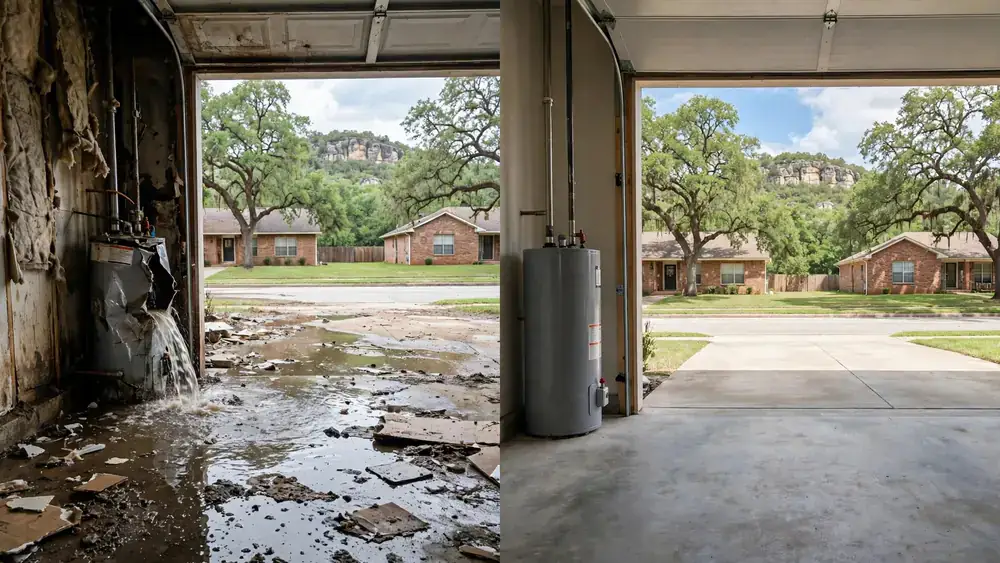
Attached garages on ranch homes usually sit a step lower than the house, and that is on purpose. But garages often collect the first water of a storm, and they are where many households store boxes, photo albums and tax papers on the floor. Put them on shelves or in plastic bins. Water heaters in a garage are commonly raised on a stand, and it is worth seeing that yours sits correctly. If your home has had its garage converted to a room, expect a floor lower than the house and a wall that sits on an old driveway edge. Such rooms take in water quite easily.
After any big storm, check the base of the walls in rooms along the outside, especially in closets where carpet is hidden by shoes and boxes. Damp pad at a closet edge may be the only sign that water found a way in. Pull out the items, feel the tack strip and sniff for a musty smell. Catching it within a day or two can mean a short drying job. Waiting can mean mold on the back of drywall, which the mold rules guide explains in relation to Texas licensing.
What dries and what goes after a Yale Park storm
Water from outside is not the same as water from a clean supply line. Once rain has moved across a lawn, street or flower bed, it can carry soil, fertilizer and bacteria. The usual thinking is that carpet pad touched by this kind of water is removed, and that the lower section of wet drywall may be cut out so the wall cavity can dry. Ask your contractor to explain the category of water they think it is, and what that means for your floors. Hard surfaces can generally be cleaned; porous ones are the problem.
Ranch homes do have one advantage here. With no upper floor to protect, equipment can be placed in a simple layout, and rooms are generally easy to reach. A wide plan may still mean a wet hallway runs through several rooms, so walls need checking on both sides. Baseboards often come off first, because they hide the wettest part of the wall. Daily readings show whether drying is on track. The water extraction and drying page sets out the steps, and the drying time guide shows what may slow them down.
Indoor leaks that Yale Park homes still get
Rain is not the only risk. Homes from the 1970s and 1980s are of an age when plumbing below the slab may start to show wear, and the warning signs are a warm spot in the floor or a bill that climbs for no clear reason. Read the slab leak page if that sounds familiar. A home with a range of ages on the same street can also have a mix of original and replaced pipes, so a neighbor's experience is only a loose guide to your own. Ask what has been replaced, and keep notes.
Sewer and drain trouble also deserves a mention. If a drain backs up, stop using water and check your cleanout. The city maintains the main sewer. A stoppage between a city-installed cleanout and the house is the owner's. Report street-side problems to the city's 24/7 line on 972-744-4111. Then there is the attic, where an air handler above the ceiling may have a clogged drain line in July, leaving a stain over a hallway. Each of these is manageable when caught early, which is why a simple seasonal check around the house is so useful.
Yale Park families, schools and rentals
One listing places a home two blocks from Yale Elementary and the park, and Apollo Junior High and Berkner High are named for the area in Richardson ISD. So many homes here have children in them, and that shapes how you handle wet rooms. Keep kids out of areas with drying equipment, cords or any water that came from outside. Wash hands and toys that have touched storm water. If a bedroom is affected, plan where people will sleep, and ask your contractor how noisy the equipment will be, because it often has to run through the night.
Some Yale Park homes are rented, as rental listings show. Tenants should report water right away and in writing, and owners should tell renters where the main shut-off is. If you own a rental on one of these streets, it is worth walking the outside each autumn, as tenants may not think about gutters. Put the job on your calendar and keep a list of what you checked. Then, if something does happen, the file shows that the house was looked after, which helps when you talk with an insurer.
Yale Park insurance, permits and who to call
How water got in often decides the claim. A burst pipe is usually handled differently from rain rising across a yard, and Texas policies vary, so read yours and speak with your agent. The Texas Department of Insurance explains the basics, and the guide to insurance and water damage adds detail. Keep dated photos of the outside of the house as well as the inside. Pictures of the storm, the yard and the water line can help show the sequence of events.
If grading, drainage or structural work is planned afterward, check with Building Inspection on 972-744-4180 about permits. Changing the slope of a lot can move the problem to a neighbor, so get advice first. Registered contractors are discussed in the guide to choosing a company. Calling this site's number connects you with an independent contractor who does the work. Tell them you are near Yale Park, how the water got in, and whether it looked muddy or clean.
Driveways, sidewalks and curbs on Yale Park blocks
Streets in this part of Richardson have settled in over decades. Driveways that once sloped gently to the curb may have shifted, especially near large trees whose roots push slabs up. If yours now tilts toward the garage, a downpour will head that way. Look at how the sidewalk meets your drive, too. A raised section can act like a small dam and turn rain back to the house. A concrete contractor can often lift or replace a section without tearing up the whole driveway.
Keep the curb inlet near you clear if you can do so safely from the sidewalk. Leaves from street trees collect there in autumn and can back water up into the gutter and across low yards. If the inlet is fully blocked and water is rising in the street, use the city line to report it, and do not reach into moving water. Teach children to stay away from inlets during storms, particularly near the park, as water moves faster and with more force there than it appears to from a distance.
Fences, sheds and backyard slopes in the Yale Park area
Backyards change a lot over 40 or 50 years. Sheds appear, patios get extended, flower beds rise and new fences go in. Each one can alter how rain leaves the lot. A shed on a slab may sit right in the old drainage path. A fence with a concrete footing or solid boards at the ground can hold water back until it finds the house. If water never used to pool at your back door, think through what has been built since.
Simple fixes tend to work best. Leaving a small gap beneath a fence, moving a raised bed, or adding a shallow grass swale can restore the flow. Where a problem is more serious, a landscaper may suggest a surface drain. If so, ask where it will release water, since sending it to a neighbor is not a real fix. Check the drain inlet after each season, too, because leaves and soil can fill a buried pipe in a surprisingly short time, and a clogged drain is worse than none at all.
Photos, keepsakes and paper in a Yale Park flood
Families who have lived in one house for decades tend to store irreplaceable things in low places, such as closets, cabinets and the garage floor. If storm water reaches them, act quickly but carefully. Wet photos can often be rinsed in clean water and laid out to dry, face up, on a clean surface. Paper can be frozen to pause mold growth until there is time to deal with it. Do not stack anything wet in a closed plastic bag at room temperature, because mold can begin within a couple of days.
Anything touched by muddy outside water needs more caution than items wet from a clean pipe. Soft toys, bedding and porous goods may not be worth keeping, while hard plastics and glass can usually be washed and disinfected. Make a list before you throw things away, with photos of each item. It takes time, but insurers generally want this. Next, think about moving what matters most to a high shelf for good. Doing that on a dry weekend is easy, and it can spare you a painful sorting job later.
A storm-season list for Yale Park homes
- Clear gutters and roof valleys
- Pull soil and mulch below the brick line
- Check the garage door bottom seal
- Open the weep holes in sliding door tracks
- Lift garage boxes off the floor
- Look up your address on the FEMA map
FAQ
Yale Park and Yale Place questions
Is Yale Place a separate neighborhood from Yale Park?
Research found Yale Place as a street within the area, not a separate subdivision, so this page covers both.
Does Yale Park flood?
No specific event turned up in research. Check your own address on FEMA's map, since heavy rain can reach low entries anywhere.
Why did water come in under my Yale Park garage door?
A worn bottom seal or a driveway sloping toward the house are common reasons. Check both during the next steady rain.
Does homeowners insurance cover rain rising into a Yale Park home?
Rising outside water usually needs flood coverage, while wind-driven rain may be treated differently. Ask your agent to confirm.
Can wet carpet in a Yale Park room be saved after a storm?
Outside water often means the pad must go. Whether the carpet stays depends on the water type and how long it sat.
What is the Owens Trail near Yale Park?
It is a paved Richardson trail, and Yale Park on Linda Lane is listed as a parking spot for its southern part.
Sources and citations
- [1]TrailLink: Owens Trail
- [2]County trail document: Owens Trail
- [3]Listing: 1803 Yale Place
- [4]Homes.com: Yale neighborhood guide
- [5]TopHap: Yale Blvd addresses
- [6]FEMA Flood Map Service Center
- [7]City of Richardson: Water utility operations FAQ
- [8]City of Richardson: 24/7 Response Center
- [9]City of Richardson: Residential permit types
- [10]Texas Department of Insurance: Water damage and mold coverage