
Key facts: The Commons at Spring Creek
Builder warranties at The Commons at Spring Creek
With homes this young, many original owners may still hold a builder's warranty, or a third-party structural warranty that was transferred at closing. These documents vary widely, and a claim is usually subject to conditions such as written notice, access for inspection, and a limited window for each kind of defect. Before anything is cut open, find your warranty booklet and read the section on plumbing and water intrusion. A workmanship issue, such as a poorly made fitting or a missing flashing, may be something the builder should address, and removing the evidence too early can complicate that conversation.
This does not mean waiting while water runs or drywall soaks. Stop the leak, protect the home and begin drying, as an insurer will normally expect. Just document it carefully as you go. Take photographs of the failed part in place, save the part itself, and ask the plumber to write down what failed and why. Then send notice to the builder at the address in your warranty, using a method that leaves a record. If you bought a resale home, ask what passed to you with the title, since some coverage ends or changes at transfer.
HOA lines inside The Commons at Spring Creek
Listings mark the association as mandatory, and show monthly dues. What those dues pay for is decided by the recorded declaration, not by a listing, and it is the document to read first. In some townhome communities the association looks after roofs, exterior walls and common landscaping, while owners keep everything inside. In others, the owner holds almost all of it and the association handles only common land. Those are very different positions when a roof or a wall leaks, and it would be a mistake to assume which one you are in.
Find out now, not during a loss. Ask the management company for the declaration, the insurance summary and the name of a contact. Check whether the association holds a master policy and how that policy treats interior finishes, because this determines what your own policy needs to cover. Any exterior repair may also need association sign-off, including patches to brick, siding or a roof. Keep a copy of every written request. If several homes are affected by one event, ask the association to coordinate, since one contractor working from one plan is often easier than four people each making separate calls.
Who to contact at The Commons at Spring Creek
| What you see | Likely first contact | Keep a record of |
|---|---|---|
| Water through a Heritage Place shared wall | Neighbor, then association manager | Time noticed, photos on both sides |
| New-home fitting leak in your upstairs bath | Plumber, then builder under warranty | Failed part, plumber's written note |
| Ceiling stain under a townhome roofline | Association manager or roofer per declaration | Date of storm, photos of the ceiling |
| Water bubbling near the street | City line at 972-744-4111 | Location and time of the report |
| Wet carpet after a washer hose failure | Your insurer and a drying contractor | Moisture readings, damaged items list |
Upper-floor bathrooms and laundry in Commons townhomes
Townhome plans tend to stack rooms to use a narrow footprint, so bedrooms, baths and laundry are often placed above living areas. Where that is true, gravity is the main concern. A failed washing machine hose or a toilet supply line on an upper floor can run for some time before anyone downstairs notices, and it reaches every layer on the way: carpet, subfloor, insulation, the ceiling below and any cabinets under that. If you are unsure how your plan is laid out, spend ten minutes finding out what sits below each wet room.
A few small steps reduce the risk. Check that a laundry room upstairs has a drain pan under the washer, and a working floor drain if one was installed. Turn off the washer valves when you go away for more than a day or two. Keep a shoe-box-sized leak sensor under the sink and behind the toilet. Because the home is new, connectors should be in good shape, but new does not mean perfectly installed. A hose that has been pushed back too tightly against a wall can kink, and that weakness may not show for a few years.
Fire walls and insulation in Heritage Place homes
Walls that separate attached homes are normally built to resist fire, and that affects how water damage gets handled. These assemblies can have multiple layers of board, and sometimes an air gap between them. Water that enters may dry slowly, and a contractor cannot simply slice through one without thinking about what the wall is doing. Any repair should restore the fire-rated construction as designed, and the [Building Inspection office](https://www.cor.net/departments/building-inspection/residential/permit-types) at 972-744-4180 can say whether a permit is needed for that work.
Sound insulation adds another layer. Batts in a party wall or floor hold moisture like a sponge, and they usually have to be taken out once soaked. Ask your drying contractor how they will test inside the wall, not only on its face, and how the neighbor's side will be checked. Moisture meters and thermal cameras help, although a camera shows temperature differences and should be confirmed with a meter. Drying in attached homes often takes coordination, because the air movers in one unit may be pushing moisture toward a wall its neighbor has not opened.
What to do in the first hour at The Commons at Spring Creek
- 1
Close the valve
Use the fixture valve if it is clear what failed, otherwise the main. Learn where the main is inside your townhome now.
- 2
Tell the neighbors
Knock on the doors either side, and on any home that shares a wall with the room involved.
- 3
Record it
Take wide and close photos, including the failed part, before anything gets moved or thrown away.
- 4
Notify the manager
Send a short written message to the association contact, with the time, the location and what you see.
- 5
Contact insurer and builder
Open a claim if needed, and give any warranty notice in the way your documents require.
New-construction moisture in a Commons at Spring Creek home
Newly built homes contain a lot of moisture in their first couple of years. Concrete, framing and paint keep giving up water as they cure, and modern houses are sealed tightly. That can make a first-year house feel a bit damp and can leave condensation on windows on a cold morning, and it may lead an owner to worry about a leak that is not there. Equally, the same conditions can disguise a real one. Compare by looking at the pattern. Condensation sits on glass and cold surfaces, and tends to fade through the day, whereas a leak leaves a spot that grows or returns in the same place.
Run the bath fans for a while after showers and keep the air conditioner in normal service, even when you are away, since it removes humidity. If you are going out of town, set it higher but leave it on. Keep a small hygrometer on a shelf; the EPA suggests indoor humidity below about 60 percent. Cracks in new drywall tape or nail pops are often normal shrinkage rather than water damage. If the paint bubbles or the surface feels soft, that is a different signal, and worth a moisture reading.
Roof terraces, balconies and flashing near CityLine
Modern townhomes often have tall narrow facades, with mixed materials, parapets, balconies or small roof decks. If your home has any of these, the details where different surfaces meet deserve attention. Water tends to enter through a joint, not through the middle of a field of brick. Look at the base of door thresholds on upper levels, where a balcony deck meets the wall, and at the sealant around windows and pipe penetrations. Listings suggest these homes are close to new, but sealants are still a maintenance item and can fail early if they were not applied well.
Wind matters here too. North Texas storms drive rain sideways, and a joint that stays dry in steady rain may leak once it is hit from a certain direction. If you see staining only after particular storms, note the wind direction and the date. That is real evidence for a roofer, a builder or the association, and it is more helpful than a general complaint about a damp wall. Do not climb onto a roof to look for yourself. Photos from the ground or a window are usually enough to begin the conversation with whoever is responsible for the exterior.
Spring Creek, runoff and paved surroundings
The community's name refers to Spring Creek, and the wider area around CityLine is heavily built up, with roofs and paving that shed rain quickly instead of soaking it in. How that affects your particular townhome is something only your address and the site's grading can answer. Check the FEMA Flood Map Service Center for your address, and read the notes on any survey you received at closing. A short look at your own patio or garage apron during a heavy downpour tells you a good deal about where water wants to go.
In small townhome sites, drainage is often engineered as a system, with shared swales, inlets and buried lines. Blocked inlets, mulch washed into a yard drain or a neighbor's landscaping project can change how water moves across several lots. If water stands against a wall or reaches a garage door, tell the association and ask who looks after the drains. If it reaches inside, the storm cleanup page sets out what to do. Standard home policies generally treat outside flooding separately, so check whether you hold a flood policy before you need one.
Insurance layers for a Commons at Spring Creek owner
Townhome insurance can be confusing, because more than one policy might respond. Yours may be a full homeowners policy, or a form written for a unit under an association master policy. The master policy, if there is one, may have a deductible that gets passed along to the owner where the loss began. Your own policy may include loss assessment coverage for this situation. Ask your agent to compare the declaration with your policy line by line. This takes one phone call, and it answers most of the questions people end up asking in the middle of a claim.
The Texas Department of Insurance explains how sudden water damage and mold are usually handled. If a neighbor's leak damaged your home, report it to your own insurer anyway, and let the companies work out who is responsible. Avoid agreeing to anything about blame on the spot. Keep your communication friendly and factual, and stick to what you saw. The insurance guide has more on documenting a loss. Keep photos, receipts and a timeline in one shared folder, so that all those involved can see the same record.
Air conditioning condensate above Commons living spaces
Even a brand-new system produces gallons of condensate on a humid day. In a townhome, the air handler may be in an attic or a closet on an upper floor, directly above finished rooms. Construction debris left in a new condensate line is a known cause of early clogs, so a problem can occur even in the first summers. If your system has a float switch and the AC stops working, check for water before you reset it. Look at the auxiliary drain outlet too. Water dripping from an outlet above a window is a warning that the main line is blocked.
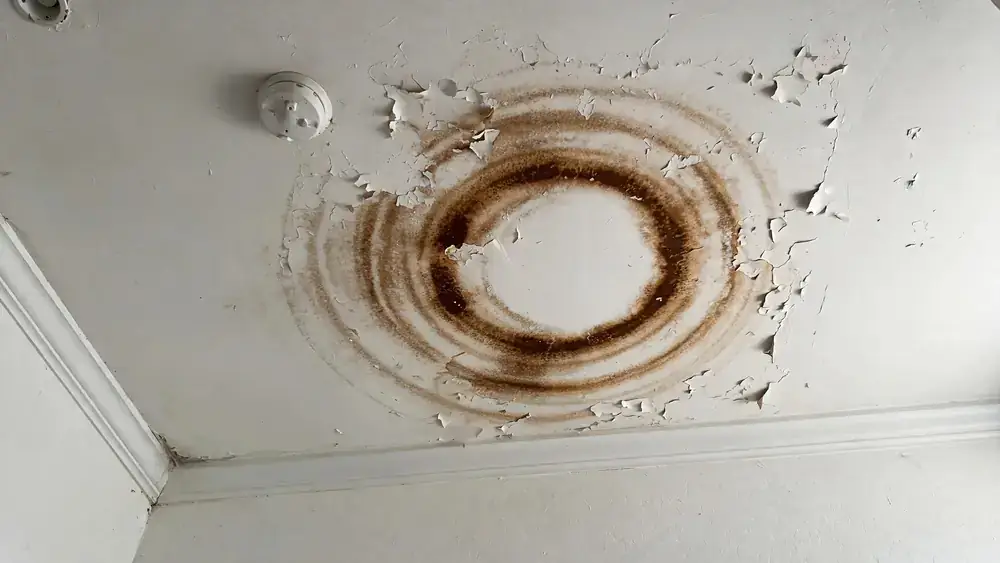
Have the line checked as part of the regular service, and keep the records with your warranty file. If a ceiling shows a ring, the AC leak page explains the next steps. A leak in an upper-floor closet may also run down a shared wall, so tell your neighbor if you find one. If growth appears, the EPA guidance and the Texas rules in the mold guide apply as they do in any home, and they matter in a shared wall because mold in one home can become a question for the next.
Getting to know your Heritage Place townhome
Newer owners often have not yet had a reason to learn where things are, and in a young house there may be no one on the block who has been through a leak. Spend an hour on it. Find the main water shut-off and try it. Find the panel, the water heater valve, the sewer cleanout, and the valves behind each toilet and under each sink. Photograph them. Write the main shut-off location on a card inside a kitchen cupboard, and show anyone who regularly stays in the house, because a guest in a stranger's home will have no idea where to look.
Keep a folder of everything that came with the home: warranty booklet, declaration, plumbing diagrams if the builder supplied them, and the appliance manuals. Add the manager's contact, your agent's number and the city line, 972-744-4111, for water or sewer problems in the street. Richardson maintains the main sewer, and a stoppage between a city-installed cleanout and the house falls to the owner, which in attached housing makes it worth asking how your lateral connects. A prepared owner in a 58-home community also helps the neighbors, since one person's readiness can limit how far water travels next door.
Renting out or leaving a Commons at Spring Creek townhome empty
A location beside CityLine suits people who travel for work, and a townhome can sit empty for days at a time or be let to a tenant. An empty home is where a small leak does the most harm, and here it can also reach a neighbor. Before a trip, close the main shut-off if your plan allows it, leaving anything that needs water, such as a fire sprinkler line, untouched. Ask someone with a key to walk through every few days, and tell the association manager who that is.
If you rent the home out, check that the lease and the association rules line up, and give the tenant the shut-off location and the manager's contact on the first day. Your insurer should know the home is rented, because an owner-occupied form may not suit it, and many policies limit cover for a home left vacant. Ask your agent how many days count. In a community of only 58 homes, a single contact sheet shared among neighbors is a practical way of making sure someone can act when an owner is away.
FAQ
The Commons at Spring Creek water damage FAQ
My Commons townhome is new. Does the builder pay for a leak?
That depends on your warranty and on what failed. Give written notice as the warranty requires, and keep the failed part.
Does the HOA at The Commons at Spring Creek cover my interior?
Read the declaration and the insurance summary. Listings show a mandatory association, but its duties are set by recorded documents.
My neighbor's leak came through a shared wall. Who do I tell?
Tell the neighbor and the association manager, photograph it, and report it to your own insurer.
Can a contractor cut into a Heritage Place party wall?
Only with care. Shared walls often have a fire rating that must be restored, so ask about the plan and any permit first.
Is damp in a first-year Commons at Spring Creek home normal?
Some construction moisture is normal in the first couple of years. A spot that grows or comes back should get a moisture reading.
Sources and citations
- [1]Listing: 3458 Heritage Place, Richardson
- [2]Listing: 3470 Heritage Place, Commons at Spring Creek
- [3]City of Richardson: 24/7 Response Center
- [4]City of Richardson: Water utility operations FAQ
- [5]Texas Department of Insurance: Water damage and mold coverage
- [6]EPA: A brief guide to mold, moisture and your home
- [7]TDLR: Mold assessors and remediators FAQ
- [8]FEMA Flood Map Service Center