Key facts: West Prairie Creek
Life beside the water at West Prairie Creek
Prairie Creek Park is a well-known local surprise. Trail guides describe a small greenbelt with a footbridge and a waterfall, tucked between Campbell and Renner just east of Central Expressway. The only official parking is reported to be on West Prairie Creek Drive. Listings along that road talk up the views: one home is described as overlooking the park, and another, built in 1980, sits on a creek lot.
A creek that makes a waterfall after rain is also a creek that rises after rain. Hikers are warned to expect mud in wet weather, and a general guide to waterfalls here notes that creek-fed falls are strongest a day or two after a storm. None of that means that homes here have flooded, and this page makes no such claim. It does mean that owners should know how water moves across their own lot, because it varies from one address to the next.
Check your West Prairie Creek address on the FEMA map
Begin with the facts about your exact property. Enter your address at the FEMA Flood Map Service Center and read the zone shown. Being close to a creek does not automatically place you in a mapped floodplain, and being outside of one does not make you safe. Maps also change, so a result from when you bought the house may be out of date. If your lot looks borderline, a land surveyor can give you the elevation details a lender or insurer may want.
The local guide for Prairie Creek Estates makes the same point in its own way, advising buyers of creek-side homes to look into drainage, retaining walls and flood information. That is good advice for anyone on this stretch. Buyers can also ask the seller for any past flood claims and any elevation certificate. Texas sellers commonly complete a disclosure, but it is only as good as what the seller knows, so check the public maps yourself.
How West Prairie Creek lots differ
| Lot position | Main concern | What to inspect |
|---|---|---|
| Backing directly onto the creek | Bank movement and rising water | Retaining walls, fence lines, rear doors |
| Greenbelt view above the creek | Slope drainage toward the house or away | Grading, patio slope, weep holes |
| Interior lot off Fall Creek Drive | Street runoff and blocked gutters | Downspouts and garage threshold |
| Corner lot near Prairie Creek Park | Two-sided curb runoff | Driveway dips and side-yard swales |
| Courtyard home in Prairie Creek Estates | Trapped rain in enclosed patios | Courtyard drains and door sills |
Retaining walls behind West Prairie Creek homes
Retaining walls hold back a lot more than they appear to, and water is usually what brings them down. Soil behind a wall gets heavier when wet. If weep holes are clogged or the drainage behind the wall has failed, pressure builds up. Signs of trouble include leaning sections, wide cracks, stair-step gaps in masonry and soil that is washing out at the base. A wall failure at the rear of a lot can also change how water reaches the house.
Inspect any wall yourself in dry weather and again a day after a good rain. A clean flow from the weep holes is normally a good sign. A dry wall with a soggy yard above it is less encouraging. Work near a creek may also involve city rules, so talk with Building Inspection at 972-744-4180 before you rebuild or add a wall. An engineer can tell you whether what you are seeing is cosmetic or structural.
Sloped yards and walkout rooms along West Prairie Creek
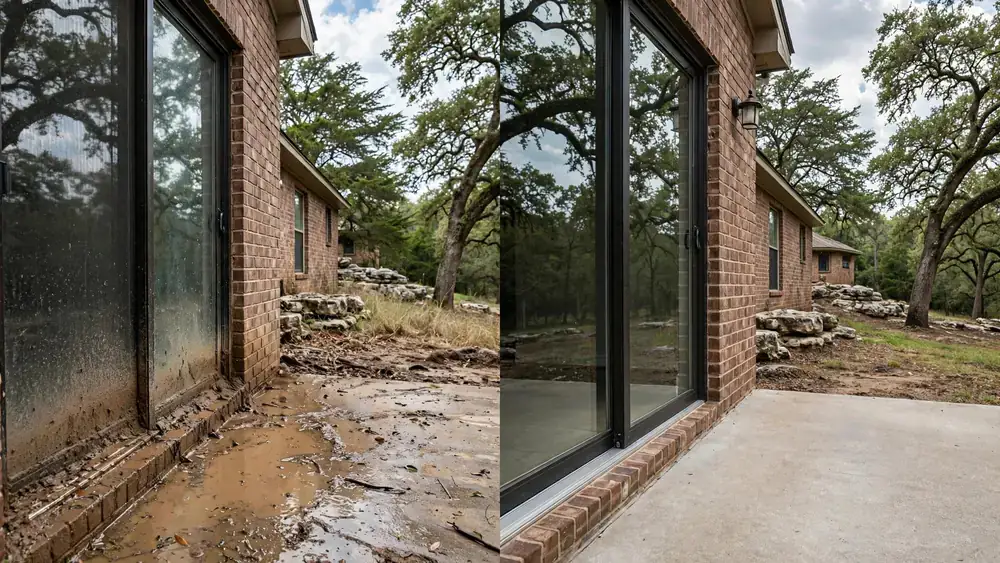
Lots that fall toward a creek or greenbelt may look like they drain beautifully, and most of the time they do. The risk comes from the uphill side. Water heading for the creek has to get around the house first, and a side yard that has settled or a raised bed can steer it toward the slab. Rear patios and sunrooms often sit at a lower level, and a patio door may be the first thing water reaches.
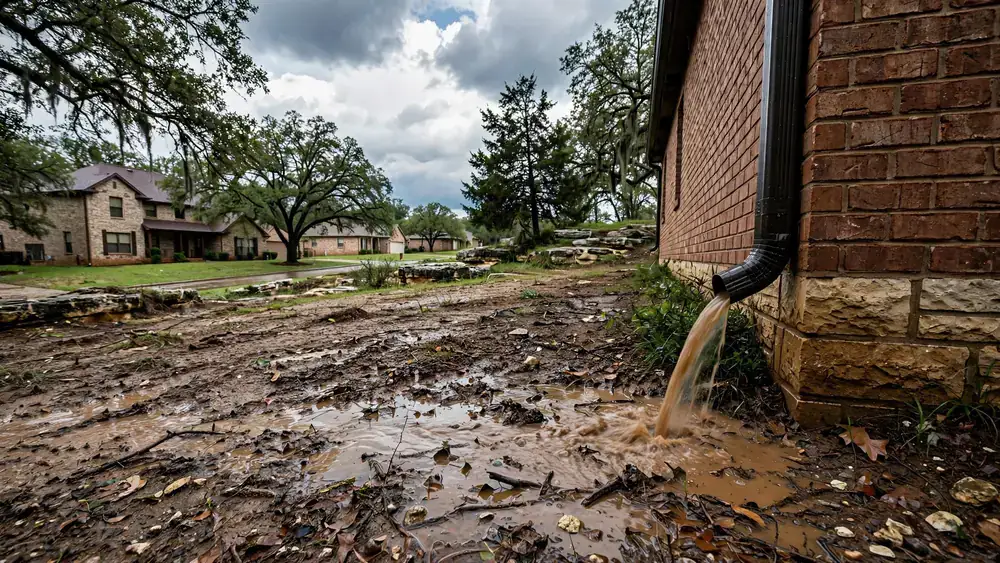
Watch your yard in a downpour. Note where water pools, where it runs and whether it touches brick. A shallow swale, an extended downspout or a corrected patio slope can solve many of these problems. If muddy water has already come in, the storm and flood page explains why that water is treated as contaminated.
- Watch one real storm
- Extend downspouts
- Keep beds below the slab line
When creek water reaches a Prairie Creek home
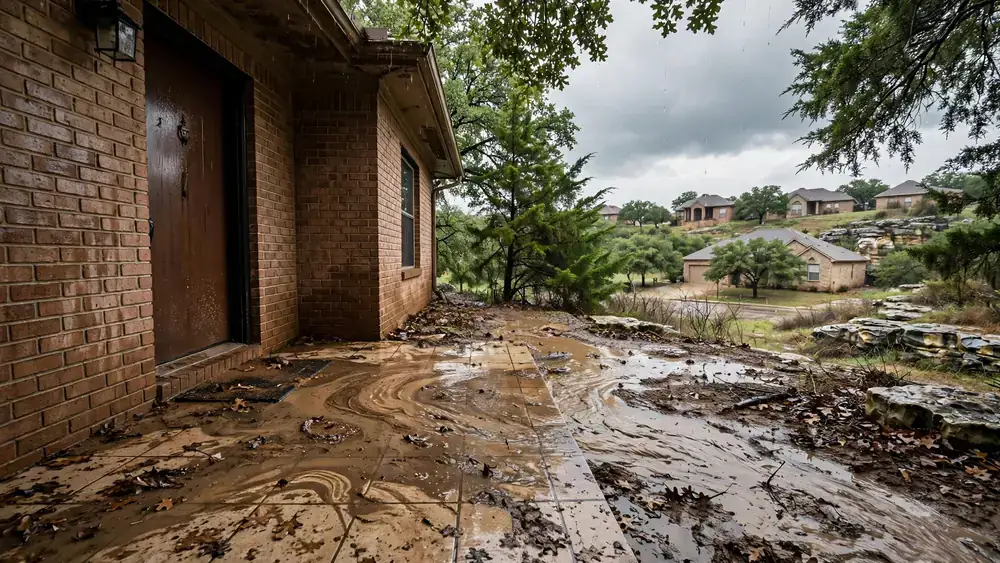
Flood water from outdoors is a different class of problem from a burst pipe. It can carry silt, runoff from streets and yards, and whatever was in the storm drains. Stay out of it if you can, and do not walk through anything that may be energized. Do not try to drive or wade across flowing water on a low street. When it is safe to go back in, wear boots and gloves and photograph everything first.
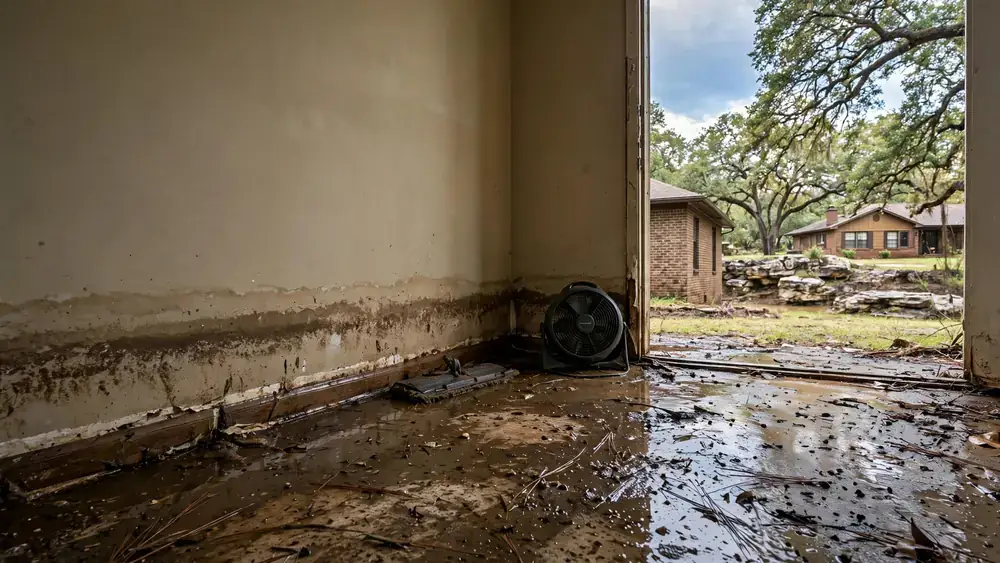
Drywall, insulation, carpet and padding that creek water has soaked usually come out, since they cannot be reliably cleaned. Hard surfaces can be cleaned and dried. The thin layer of silt left behind looks harmless, but it holds moisture and contaminants, so ask that it be removed thoroughly before anything is sealed. The IICRC S500 standard treats outdoor flood water as the most serious category of water, which sets the level of care that a contractor should apply.
Flood insurance for a West Prairie Creek lot
The most important insurance fact for a creek-side owner is this: a standard Texas homeowners policy generally does not cover rising water. Flood coverage is sold separately, through the National Flood Insurance Program or private carriers, and it usually has a waiting period. So the moment to think about it is on a calm day, and not when a storm is forecast. Ask your agent whether your lot is written with a flood policy and what that policy covers.
A sudden burst pipe is treated differently from rising water, and wind-driven rain differently again. Keep that in mind when you describe an event. State what you saw without guessing at the cause. If a creek rose and a downspout also overflowed, your insurer will decide how it applies. Photos with dates, and notes on when the water arrived and when it left, are the best support. The Texas insurance guide has general background.
Getting ready for storm season at West Prairie Creek
A short check each spring covers the items that creek-area homes depend on most.
- 1
Clear the path
Rake leaves off West Prairie Creek yard drains and out of street gutters that you can safely reach.
- 2
Test the walls
Check retaining wall weep holes and look for fresh leaning.
- 3
Raise the valuables
Move papers and keepsakes out of low closets and off the garage floor.
- 4
Review the policy
Confirm whether you have flood cover and when it begins.
- 5
Save the numbers
Keep your insurer's claim line and the city's 972-744-4111 reporting line in your phone.
Homes from 1968 to 2010 in Prairie Creek Estates
A local guide reports construction years from 1968 to 2010 in Prairie Creek Estates, and it names Eastwood Drive, Forest Park Drive, Creekwood Circle and Fall Creek Drive among the streets. That is a wide span. A 1968 home is likely to have reached the stage where original drains and supply lines deserve scrutiny. A 2010 home is more likely to have trouble with appliances, connectors and attic equipment. Do not assume that your neighbor's house has the same plumbing as yours.
The other detail worth noting is that interior courtyards and covered patios show up in listings. Those features are lovely, but a courtyard surrounded by walls needs its drain to work. If the drain clogs with leaves from mature trees, the courtyard fills like a shallow pool, and the door sill becomes the dam. Check that drain each autumn, and pour a bucket of water through it to confirm that it really flows. Do the same for any patio drains, which can silt up unseen on a lot this close to the greenbelt and its falling leaves.
Trees and leaves in the West Prairie Creek greenbelt
Mature trees shade this neighborhood, and listings frequently mention them. A heavy canopy near a roof means gutters fill fast, especially in autumn. An overflowing gutter dumps water straight down along the wall, right where the foundation meets the soil. It can also back up under the shingles. Twice a year is a reasonable minimum for cleaning, and more often for a house under big trees. Screens help, but they do not eliminate the job.
Large limbs over a roof deserve an occasional look from an arborist. A fallen limb that punctures a roof turns a windy night into a water loss in minutes. If that happens, photograph the damage and arrange a temporary cover from a qualified roofer rather than climbing up yourself. Inside, move belongings out of the way and catch what you can.
Foundations near the creek at West Prairie Creek
The clay common in this part of Texas swells when wet and shrinks as it dries. Near a creek, soil moisture can vary a great deal across one lot, with a damp rear yard and a dry front yard under a shade tree. Differential movement like that can strain slabs and the pipes inside them. Sticking doors and cracks over door frames are common hints, though they can have other causes too.
A moving slab can in turn crack a buried line. If you see a damp patch that has no surface explanation, or your water meter turns with everything off, have a plumber test the system. A slab leak on a creek lot is easy to mistake for groundwater, and each calls for a very different fix. Accurate diagnosis first can spare you a lot of disruption.
Inside-the-house leaks on West Prairie Creek Drive
It would be easy to read this page and think that everything comes from the creek. Most water damage in any neighborhood begins indoors. A 1980 house on a creek lot has the same supply lines, water heater and washing machine hoses as any other home of that age, and those parts wear out regardless of the view. A larger home with four bathrooms, like the one described in the W Prairie Creek listing, has more of them to look after.
Know where your main shutoff is. Replace rubber washer hoses with braided ones, and check under sinks a few times a year. When a pipe does burst, the burst pipe page describes what to do, and the first hour guide gives a simple order of operations. Clean water from a supply line can often be dried with far less demolition, as long as drying begins promptly.
Sewer lines in the low parts of West Prairie Creek
Creek valleys are natural routes for sewer mains, as gravity carries wastewater downhill. That is common to many cities and is not a statement about any specific street here. Homes at lower elevations do tend to be the first place a backup appears if a line blocks, because sewage takes the lowest exit available. If your floor drain or lowest toilet is the one that gurgles, take note.
Richardson says that it maintains the main and that a stoppage between a city-installed cleanout and the house belongs to the owner. Report anything surfacing in the street or the greenbelt at 972-744-4111. For the house itself, ask a plumber whether a backwater valve makes sense for your layout. Insurance for sewer backups is often an optional add-on, so check whether you have it before you need it.
Mold in shaded West Prairie Creek rooms
Rooms on the shady creek side can stay cool and damp, particularly lower-level rear rooms with limited airflow. After any leak, these are the rooms that dry slowest. Run the air conditioning, keep closet doors open and bring in dehumidifiers as soon as a contractor recommends them. The EPA points to 24 to 48 hours as the window for drying before mold can begin to grow. After a flood, that window is often harder to hit.
Do not rely on bleach or paint to deal with mold on porous materials. If you see growth, read the mold rules guide and hire a licensed professional when the work calls for one. It is worth a look under rugs and behind furniture on outer walls whenever a long wet spell ends, simply because those are the places nobody thinks to check.
Pools, irrigation and outdoor plumbing along West Prairie Creek
Homes on larger lots in this area often have sprinkler systems, and some have pools, outdoor kitchens or hose bibs far from the house. Every one of those adds piping that runs through the yard, frequently through soil that shifts. A broken irrigation line can soak the ground beside a slab for weeks, and on a sloped lot that water may surface somewhere quite far from the break. If a section of lawn stays unusually green or soft during a dry spell, follow that clue before it reaches the house.
Read your water meter with everything turned off, including the sprinkler controller. If it keeps moving, you have a leak somewhere, and a plumber or irrigation technician can separate the indoor lines from the outdoor ones. Meter location varies, but on many lots it sits in a box close to the street. Before a freeze, drain or protect outdoor lines as your system requires, because a split line in a far corner of the yard can run unnoticed for a long time. Wet ground around a pool deck deserves similar attention, and the pool company can pressure test its own plumbing.
Sprinkler heads aimed at a wall are a common and very avoidable problem. Water that strikes brick every morning finds the small gaps around windows and works its way behind the veneer. Walk your zones once each spring, watching where each head actually throws, and adjust any that hit the house, the fence or the patio. On a slope, shorter and more frequent cycles let the soil absorb the water, instead of sending it downhill toward the creek or a neighbor's yard.
FAQ
Questions from West Prairie Creek homeowners
Is my West Prairie Creek lot in a floodplain?
Check your exact address at the FEMA Flood Map Service Center. Lots on the same block can differ.
Does homeowners insurance cover creek water at West Prairie Creek?
Standard policies generally exclude rising water. Flood coverage is usually a separate policy, so ask your agent.
My retaining wall above Prairie Creek is leaning. Who should look at it?
An engineer can assess it. Ask Building Inspection at 972-744-4180 what work near the creek requires.
Can silt on a West Prairie Creek floor be mopped up?
Treat it as contaminated, wear protection and have it cleaned fully. Soaked porous materials usually come out.
Which subdivision am I in on West Prairie Creek Drive?
Listings show both Prairie Creek Estates and Prairie Creek Meadows along the road. Your deed or plat will say.
Who do I tell about water surfacing near Prairie Creek Park?
Call the City of Richardson's 24/7 line at 972-744-4111 for leaks or sewer problems.
Sources and citations
- [1]Dustin Pitts: Prairie Creek Estates neighborhood guide
- [2]Doug Newby: 2718 W Prairie Creek Drive
- [3]Hiking Project: Prairie Creek Park
- [4]FEMA Flood Map Service Center
- [5]Estately: 2307 W Prairie Creek Drive
- [6]Texas Department of Insurance: water damage and mold coverage
- [7]City of Richardson: 24/7 Response Center