Key facts: Canyon Creek
Why rain is the first question in Canyon Creek
Most Richardson neighborhoods sit on fairly gentle ground, and their water stories begin with a pipe. Canyon Creek is a little different. A 2014 write-up by a local real estate team says the name comes from the creeks and streams crossing the neighborhood, and the homeowners association lists creeks, parks and trails among its main features. Prairie Creek Park, one of the city's better known green spaces, lies along this side of town, and listings on Lookout Drive often advertise how close it is. Water is part of the appeal here, and it also decides where trouble tends to collect.
That does not mean every creekside lot gets wet. Plenty of homes here have stayed dry for sixty years, and nothing in this page suggests any particular street has flooded. It means that when a Canyon Creek owner finds damp carpet after a storm, the sensible first step is to look outside. Ask where the water came from, which way the yard falls, and whether the wet area is along an outside wall. The answer changes who you call, what your insurer asks and how the drying should be planned.
Sloped Canyon Creek lots and water at the slab edge
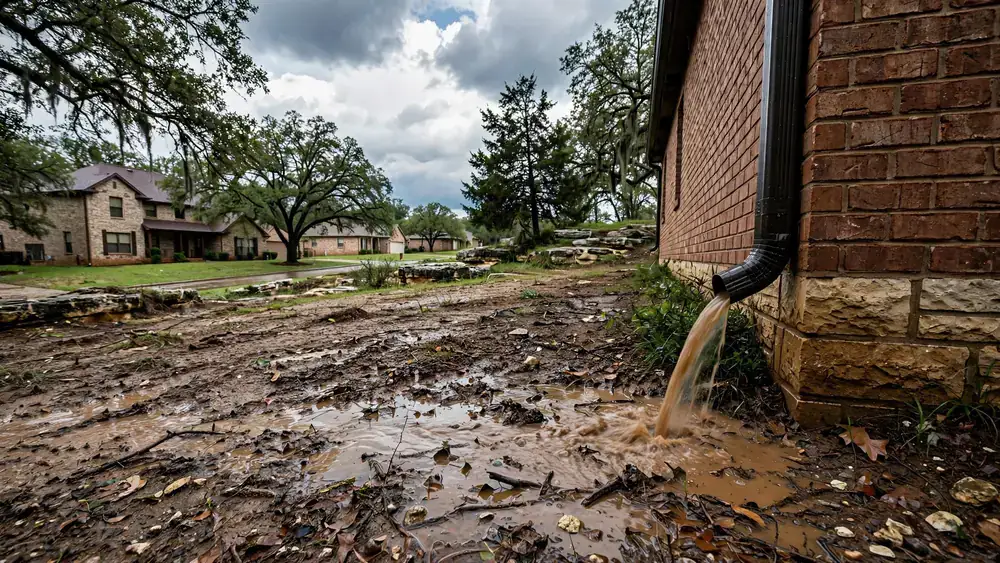
A lot that falls toward a house behaves differently from one that falls away from it. On a block with some grade, the uphill neighbor's runoff, your own roof water and the street can all arrive at the same patch of ground. Clay soil takes in very little during a hard storm, so the water moves across the surface until something stops it. That something may be your patio edge, a raised flower bed or the base of a sliding door.
Walk the lot during steady rain, not after it. You will see which downspouts empty against the house, where the lawn holds a sheet of water and whether a retaining wall is acting like a dam. Many owners here have added stone edging, pools and raised planting over the decades, and each of those changes can quietly redirect flow toward the slab. A small regrade or a longer downspout extension often solves more than any repair inside. If water has already come in, the storm and flood cleanup page explains how silty water is handled differently from a clean supply leak.
Canyon Creek ranches and contemporaries from the 1960s
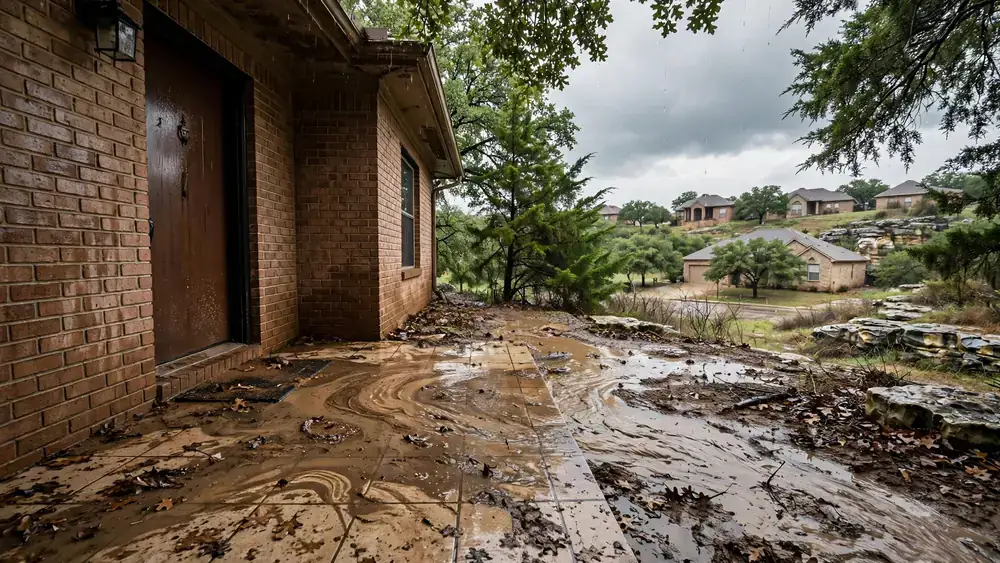
A neighborhood profile dates the community to 1963, and listings commonly show homes from the middle and later 1960s, with later building in some sections. Local guides call the tree-lined streets mainly ranch style, while modern home listings also point to California Contemporary designs. The real estate team mentioned above gave sizes of roughly 1,800 to 4,000 square feet. Treat all of that as a general picture and check the year built for your own address, because a neighborhood of this size was not finished in one go.
Those two styles fail in different ways. A long brick ranch has a big footprint, a long run of plumbing and many feet of exterior wall at grade. A contemporary often has a lower roof pitch, wide overhangs, large panes of glass, clerestory windows and interior beams carried through to the outside. Those details are handsome, yet flat and low-slope sections shed water slowly, and each place where a beam or glass wall meets the roof depends on flashing and sealant. So a ranch owner should think first about floors and a contemporary owner should think first about the roof line.
Low-slope roofs and glass walls on Canyon Creek contemporaries
If you own one of the more modern homes, a ceiling stain may be a long way from the actual leak. Water that gets through a low-slope section can travel along decking or a beam before it shows. Staining near a clerestory, at a skylight or where a beam passes through a wall deserves a roofer's attention even when the shingles or membrane look sound. Sealants age faster than the materials around them, and foliage from mature trees can hold moisture in valleys and at scuppers.
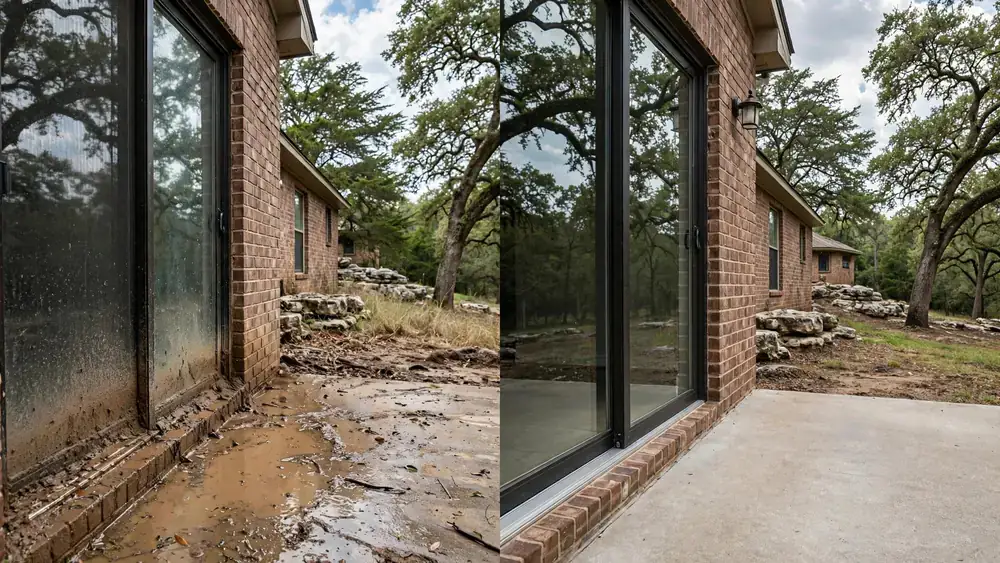
Tall glass adds another path. Rain driven against a sliding wall can pass the track and wet the carpet or wood along the threshold. Look at the corners of the tracks after a storm and clear the small weep holes if they are clogged. Wood flooring near glass often cups before anybody notices a leak at all. If that happens, measure before replacing anything, because boards laid over a wet slab can look fine and still hold moisture beneath them. A reading taken only at the surface may not tell you that.
Canyon Creek water problems by part of the home
| Part of the home | Likely source | What to check first |
|---|---|---|
| Rear door facing a creek or greenbelt | Surface runoff, blocked yard drain | Yard grade and drain inlets |
| Low-slope roof on a contemporary | Aged flashing, ponding | Stains near beams and clerestories |
| Long ranch hallway | Buried supply line under slab | Warm spots, meter movement |
| Pool side of the house | Equipment lines, overflow piping | Soggy ground near pool plumbing |
| Second-story addition | Bathroom or laundry above | Ceiling directly below wet rooms |
Trees, clay and irrigation on Canyon Creek streets
The association points to large mature trees as a defining feature, and they are. Big roots draw a great deal of moisture from clay during a hot Texas summer, while the far side of a house may stay evenly damp from sprinklers. When soil shrinks on one side and swells on the other, the slab can flex slightly. Over decades, that movement can stress supply lines and drains beneath it. This is general behavior in North Texas clay, not a diagnosis of any one home, and a licensed plumber or foundation professional can tell you what is happening at yours.
Irrigation is the piece many owners overlook. A sprinkler head aimed at the brick, or a broken line in a bed along the foundation, can keep the bottom of a wall wet all season. Run each zone during the day and watch where the water lands. Check the base of walls near any bed where the ground stays dark. If a slab leak is suspected, turn off every fixture and watch the meter, which gives a plumber a useful starting point before any floor is lifted.
The county line and your Canyon Creek paperwork
Canyon Creek is unusual because a county line passes through it. The same 2014 write-up says homes on the north side are in Collin County and homes on the south side are in Dallas County, with a different school district on each side. Another guide says Lookout Drive marks the school split. For water damage, the district does not matter, but the county can. Your appraisal district record and some property paperwork will reflect the county you are in, so use your own tax statement instead of assuming that a neighbor across the street has the same details.
City services stay the same on both sides, because the whole neighborhood is inside Richardson. Water leaks in the street and sewer problems go to the city's 24/7 line, 972-744-4111. Building Inspection is on 972-744-4180. Before you start any rebuild, ask whether a permit is required, and keep the answer with your claim file. An adjuster may ask for that and it is easier to gather while the job is still fresh.
What to do when storm water reaches a Canyon Creek home
- 1
Stay clear of wet outlets
If water is near outlets or cords, keep out of the room and shut power at the panel only if you can reach it from dry ground.
- 2
Photograph the path
Take pictures outdoors as well as indoors, including the yard, the door threshold and any water line on walls.
- 3
Note the water type
Runoff that crossed a yard is not clean water. Keep children and pets away and do not wade through it without boots.
- 4
Call your insurer
Ask how the policy treats surface water, since it may differ from a sudden pipe leak.
- 5
Call for drying help
Describe the room, the depth and how long the water has been there so an independent contractor can plan properly.
Insurance questions after a Canyon Creek storm
The cause of a loss often decides how it is treated, and a creekside lot makes that question sharper. The Texas Department of Insurance explains that standard homeowners policies generally treat sudden water events differently from flooding, and that flood coverage is usually a separate policy. Water that came over the ground into a room can fall on the flood side of that line, while water from a burst supply line usually does not. Read your own policy, and ask your agent how it words surface water, seepage and backups. Do not assume that a neighbor's experience applies to you.
Before anything is torn out, gather evidence. Photographs of the yard during the storm, a video of water at a door, and a note of the date and time can help clarify what happened. Save a sample of cut flooring if an adjuster asks for it. The Texas insurance guide covers the wording to look for. Also look up your address on FEMA's map service before you ever need it. A map shows mapped risk at a point in time, and heavy rain can still cause problems outside a mapped zone.
Drying a large Canyon Creek house room by room
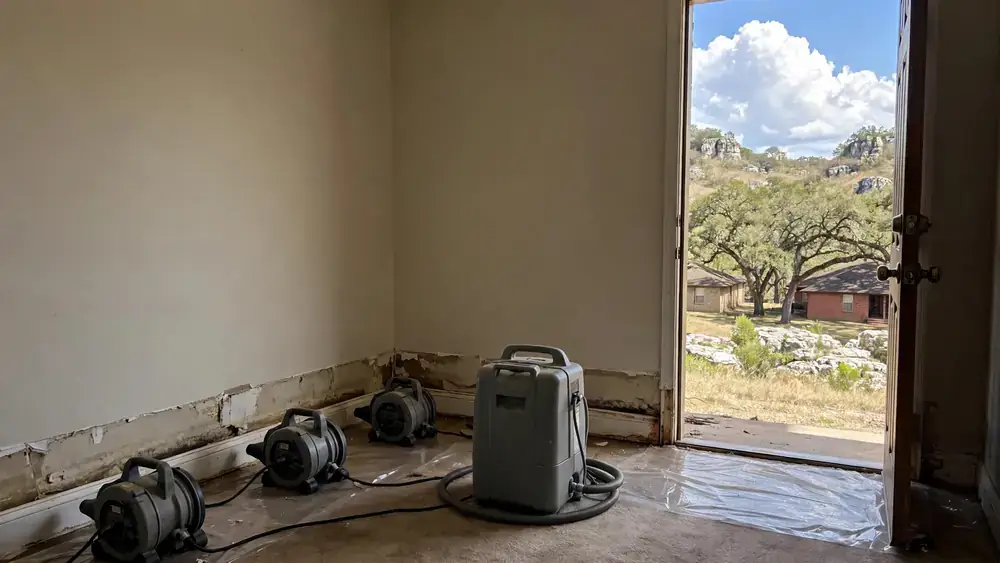
Bigger floor plans need a bigger plan. Many homes here have long hallways, sunken rooms, formal rooms at the front and a den at the back, sometimes with a mix of wood, carpet and tile. Water does not respect those transitions. It moves under baseboards and along the slab, then wicks up drywall behind furniture. A good contractor will map moisture with a meter before setting equipment, then log readings through the job, because a house that feels dry can still be holding water in the wall cavity.
Keep in mind that a sunken den can collect water from the rest of the home and may be the last room to dry. Built-in bookcases and paneling can trap moisture behind them too, so ask how those will be handled. Extraction and drying usually comes before any decision on rebuilding. Mold can begin growing quickly on damp materials, and the EPA advises drying wet items promptly. If a contractor finds mold over 25 contiguous square feet, Texas licensing rules come into play.
Pools, patios and outdoor kitchens in Canyon Creek
Pools, large patios and outdoor living spaces are common additions on bigger lots like these, and each one brings more plumbing and more hard surface. A pool line that weeps underground may show as a soggy strip of lawn, while an overflow pipe that discharges near the house can soak the soil at the slab. A covered patio tied into the main roof creates a seam where water can get behind the brick. Look at the wall where that cover meets the house, particularly on the inside, at ceiling level.
Hard surfaces also change how much water the lot has to handle. A big deck that replaced lawn sends rain to its edges in seconds. Check that patio drains are open, and that the surface slopes away from your doors rather than toward them. Sometimes old concrete settles and starts to tip back toward the house. It happens slowly enough that nobody notices until a door threshold gets wet in a storm.
Older Canyon Creek plumbing behind the updates
Many homes here have beautiful kitchens and bathrooms that were remodeled more than once, yet the lines behind and beneath may be original. A remodel rarely replaces the supply pipes under the slab. If your home dates from the 1960s, ask a plumber what the pipe material is, how old the main shut-off is and whether drains have ever been scoped. Materials used then, including cast iron for drains, can scale and crack with age, and roots from mature trees can find joints in the buried line outside.
Know where your sewer cleanout is and keep it reachable. The city maintains the main sewer, while a stoppage between a city-installed cleanout and the house is the owner's. On a heavily planted lot that cap may be under shrubs, so find it on a quiet day. If you have a home built before the 1980s, ask about asbestos before anybody disturbs old flooring, adhesive or textured ceilings. Testing may take a little time, and that is a far better outcome than spreading fibers through an occupied home.
Preparing a Canyon Creek home before the spring storms
A little work on a dry day goes a long way. Clear leaves from gutters and valleys in late autumn and again in spring, since mature trees can fill them quickly. Extend downspouts so they discharge away from the slab and onto ground that falls away. Test any yard drains with a hose to confirm that they flow. Take off debris from creek-facing fence lines on your own property if it could catch water, and never dump yard waste into a creek or a storm inlet, because that can raise the water for everyone downstream.
Indoors, label your main water shut-off and make sure everyone at home can find it. Move important papers and keepsakes off the floor of any room that sits low on the lot. Keep a simple record of past leaks, roof work and plumbing updates, since details like these fade quickly and a future buyer or adjuster may want them. Since the homeowners association is voluntary, it will not necessarily track this for you, but neighbors who have lived here for decades may remember how your block behaved in the last major storm.
Canyon Creek water heaters, attics and air handlers
Not every loss here comes from the creek side of the house. Homes of this size often have more than one air conditioning system, and an attic air handler sits directly over finished rooms. Its condensate pan and drain line take a steady flow of water through the summer, and when algae blocks the line the pan can overflow onto a ceiling. A safety float switch can shut the unit off before that happens, so ask your HVAC technician whether yours has one and test it at the start of each cooling season. The AC leak and ceiling damage page describes the usual signs.
Water heaters deserve a look too. If yours sits in an attic or in a closet beside a bedroom, a failed tank can release its contents into finished space with nobody home. Check the age on the label, look for rust at the base and confirm that any pan has a working drain. In a ranch with a long plan, the tank may also be far from the rooms it serves, which means long hot water runs through or under the slab. Warm patches on a floor can be an early clue, and worth mentioning to a plumber.
When a Canyon Creek family is away from home
A leak does its worst work when no one is there to notice. A supply hose behind a washer or an ice maker line can run for days during a summer trip, soaking floors in several rooms. Before you travel, shut the main valve if your home allows it, or at least the valves at the washer and icemaker. A neighbor with a key is worth having as well, and the flag program and street events run by the association are a natural way to get to know the people next door. Ask someone to walk through after any major storm while you are gone.
Leak sensors placed under sinks, beside the water heater and near the washer are a small step that can bring early warning to a phone. An automatic shut-off valve goes further by closing the main when it detects unusual flow. Neither one replaces routine checks, but both make sense on a large house with several wet rooms spread far apart. Ask a licensed plumber which approach suits your layout, and keep the installation records with the rest of your home file.
FAQ
Questions from Canyon Creek homeowners
Does living beside a creek in Canyon Creek mean my home will flood?
Not necessarily. Check your address on the FEMA map service, look at the grade of your lot, and remember that heavy rain can cause problems outside mapped zones.
Which county is my Canyon Creek home in?
It depends on the side of the line you are on. Your tax statement or appraisal record will show it.
Why does my contemporary home leak only in wind-driven rain?
Rain pushed sideways can get past tracks, flashing or sealant that stays dry in calm weather. Note the wind direction and show a roofer where the stain appears.
Is Canyon Creek's homeowners association responsible for my drainage?
The association describes itself as voluntary and community focused. Drainage on your lot is generally yours to manage, and the city takes reports about public sewers and water leaks.
Who do I call for water coming up in a Canyon Creek street?
Call the city's 24/7 line, 972-744-4111, which takes reports of water leaks and sewer problems.
Will a remodeled bathroom in Canyon Creek still have old pipes?
It can. Remodels often leave buried and in-wall lines alone, so ask your plumber what was actually replaced.
Sources and citations
- [1]Richardson Chamber: Canyon Creek Homeowners Association
- [2]Dallas Suburban News: Canyon Creek in Richardson
- [3]City of Richardson: 24/7 Response Center
- [4]Homes.com: Canyon Creek local guide
- [5]Neighborhoods.com: Canyon Creek
- [6]City of Richardson: Water utility operations FAQ
- [7]City of Richardson: Residential permit types
- [8]FEMA Flood Map Service Center
- [9]EPA: A brief guide to mold, moisture and your home
- [10]Texas Department of Insurance: Water damage and mold coverage