Key facts: Slab Leak Water Damage
- Expansive clay swells when wet and shrinks when dry, moving what rests on it [1].
- Many 1950s to early 1970s Richardson ranches are slab-on-grade with original supply or cast-iron drain lines [2].
- Foundation repair is among Richardson's listed residential permit types [3].
- Texas policies usually treat gradual leaks differently from sudden damage [4].
What a slab leak is
A slab leak is a leak in a water or drain line that runs in or below a concrete foundation. It may be a pressurized hot or cold supply line or a gravity drain. In many Richardson houses, these lines were laid before the concrete was poured, so there is no crawl space to look into. The first signs come up through the floor, or do not come at all.
Hot lines tend to get the most attention, because they warm the floor above them and draw the eye. Cold-water and drain leaks can be quieter. A drain leak releases water only when fixtures run, and it can wash soil out from under the slab for a long time without obvious symptoms.
Why Richardson is slab leak country
Blackland clay is the main reason this comes up so often in the Dallas area. Expansive clay swells when it takes on water and shrinks as it dries [1]. A house on that soil rises and settles slightly across the seasons, and hard droughts followed by soaking storms make the movement sharper. Rigid lines in or under the slab get flexed along the way.
Age matters as well. Local inspection notes describe many of the city's post-war ranches as slab-on-grade, some with original copper or galvanized supply lines and others with cast-iron drains [2]. Sixty years of movement, corrosion and hard water is a lot to ask of any pipe. Newer houses in Richardson are not exempt, but in an older ranch the odds climb.
Warning signs on and around the floor
Any one of these deserves a closer look. Several together deserve a call.
A warm patch on tile or wood
Often a hot line. Pets that suddenly like one spot on the floor can be a clue.
The sound of water with taps off
Listen near walls at a quiet time of day.
Water use rising for no reason
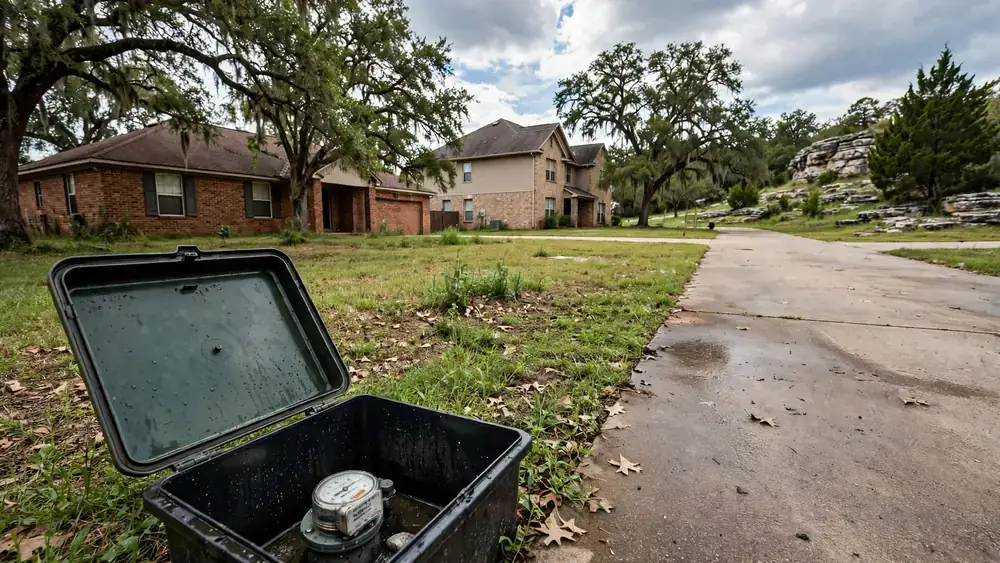
A meter that keeps moving with everything off points to a hidden leak.
Damp carpet or lifted flooring
Flooring cups, swells or smells musty along one run.
New cracks or sticking doors
Moisture changes under a slab can bring these on, though they have other causes.
How leaks are located
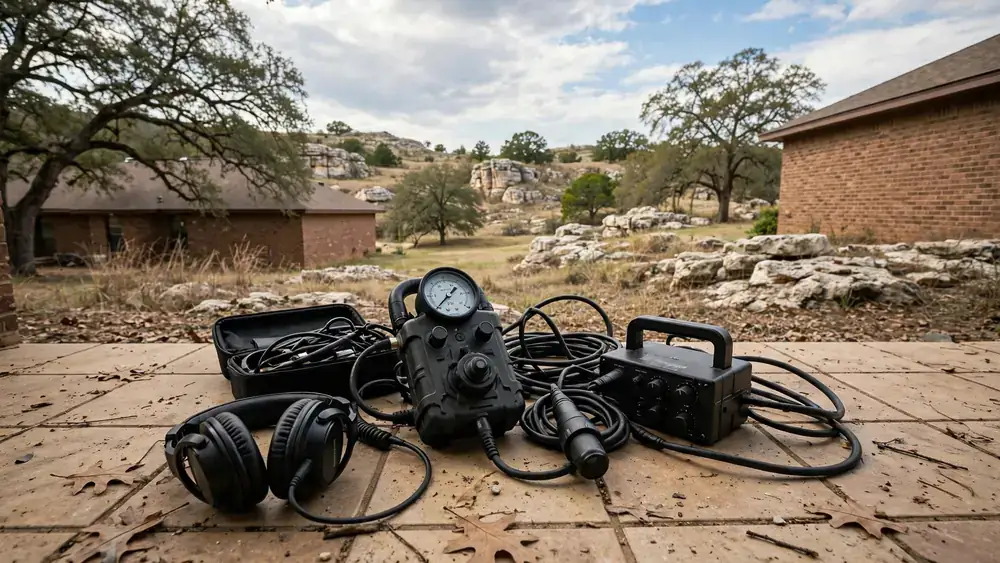
Good leak location avoids unnecessary concrete work. A plumber usually starts by isolating hot and cold lines and pressure-testing them, which shows which system has lost pressure. Electronic listening equipment then picks up the sound of escaping water through the slab. Thermal imaging can follow a hot line, and a camera can inspect drains from the inside.
Ask what the plumber is going to do to confirm the location before anyone cuts. A hit from one tool alone is less convincing than agreement between two. Texas plumbers are licensed through the Texas State Board of Plumbing Examiners [5], so ask for that number.
Three ways to deal with the leak itself
A plumber makes this call on site, based on the pipe's condition.
| Approach | What happens | Often suited to |
|---|---|---|
| Direct repair | Open the slab at the leak and fix that spot | A single, well-located failure in otherwise sound pipe |
| Reroute | Abandon the line and run a new one through walls or attic | Lines under areas that are hard to reach, or repeat leaks |
| Repipe | Replace the supply lines throughout the house | Old lines with several failures or poor condition |
Drying after a slab leak
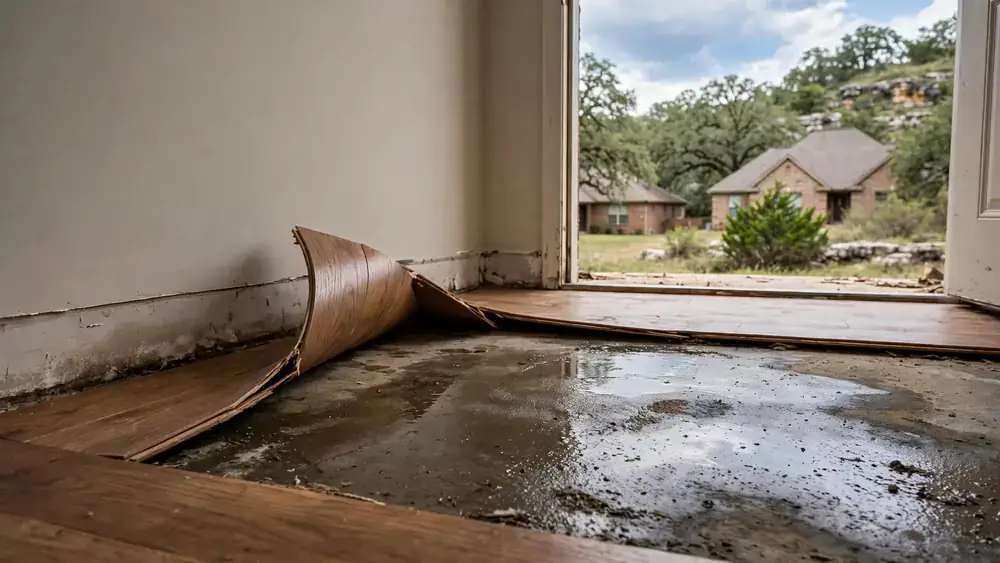
This is where restoration comes in. Water from a slab leak moves up and out through cracks, seams and the bottom of walls, so the wet zone can be wider than the repair. Carpet and pad may be soaked along one side of a room while the middle looks fine. Laminate and vinyl plank trap water beneath them and usually have to come up to let the slab dry.
Concrete gives up water slowly. Air movers, dehumidifiers and sometimes floor mats are used, and readings should be taken at marked points across the affected area. Wall bottoms need checking too, because the plate at the base of the framing sits right on the slab and can wick moisture into the drywall.
Do not rush new flooring. Adhesives and underlayments can fail, and wood can cup if the concrete under them has not dried to the flooring maker's requirement. Ask your flooring installer what moisture test the product calls for.
Hot water leaks
Why a hot line brings its own problems
A hot line leak keeps warming the area around it, so wet materials stay warm and moisture moves readily. That combination speeds up odors and swelling, and it can make the surrounding room humid.
Until the plumber arrives, closing the cold supply to the water heater often stops the hot side from feeding the leak. Then turn off the gas or the breaker, as the tank should not heat without a supply. If in doubt, close the main instead.
Slab leaks, foundations and Richardson permits
Water under a slab can change the moisture in the soil and contribute to movement, and that is one more reason to fix leaks early. But not every crack is a foundation failure, and not every foundation problem comes from a leak. If you are seeing major cracks, doors that have stopped closing or sloping floors, consider an independent structural engineer rather than relying on someone selling a repair.
Foundation repair appears in the city's residential permit list [3], and Richardson requires permits to be posted before work begins. Contractors also need to be registered with the city. If concrete is being cut and piers are being discussed, ask Building Inspection at 972-744-4180 what applies to your job.
Insurance and slab leaks in Texas
Cover for slab leaks is often the hardest kind of water claim to read. Policies commonly treat sudden damage differently from gradual leaks [4], and a leak under concrete can be both: long-running, but discovered suddenly. Some policies address access to the pipe, known as tear-out, separately from the damage itself. Ask your agent how yours is worded before assuming either way.
Keep the plumber's written findings, the location of the leak, your photographs and the drying log. Our Texas insurance guide has a list of what helps.
Mistakes that make slab leaks worse
- Laying new flooring over a damp slab
- Patching a crack without finding out where the water came from
- Ignoring a meter that keeps moving
- Treating foundation sales visits as a leak diagnosis
- Leaving wet carpet in place until the plumber has finished
- Running the water heater while the supply is shut off
Drain leaks: the quieter kind
Cast-iron drains can crack, corrode and separate over decades. Unlike a supply leak, a drain leak does not run constantly, so a meter test will not catch it. Clues include slow drains, sewer smells, damp floors near a bath or kitchen and repeat stoppages. A camera inspection is usually the way in.
Water from a drain leak is not clean. If it has reached flooring or wall bottoms, the cleanup moves into sewage rules: more removal, sanitizing and protective gear. Tell the contractor what the plumber found so that the plan fits.
After the repair: keeping an eye on things
Mark the date and location of the repair and keep the report with your house papers. Check the meter test again a few weeks later, and again after a big seasonal change. Keep soil moisture around the foundation reasonably steady in drought, and direct downspouts away from the house, as large swings in moisture are hard on any slab.
A second leak in the same system within a short time is a signal, and it is worth asking the plumber about the rest of the line. The answer should depend on what they found in the section they opened.
Is it the slab or something else?
| What you see | Could be a slab leak if | Could be something else if |
|---|---|---|
| Wet edge of carpet | It is near a run of plumbing, with no rain | It is by an exterior wall after a storm |
| Warm floor | It stays warm with the heat off | A vent or floor heating sits nearby |
| Musty smell | It persists with no visible source | There is a known AC or bath leak nearby |
| Meter moving | It stops when the main closes | It keeps moving, suggesting the yard line or irrigation |
Hot, cold and drain leaks compared
A hot-water slab leak tends to get found first, because of the warmth and because the water heater runs more than it should. People may notice that they have hot water for less time than usual, or hear the heater firing when nobody is using anything. A cold-water leak gives no such clues. It may only show up as a change in water use or, much later, as dampness along a wall. A drain leak does nothing at all until fixtures are used, and it may never rise through the slab, instead draining away into the soil.
That last kind is worth a moment's thought, because it can change the moisture under part of the house without any visible water indoors. Sewer gas smells, repeated stoppages and slow drains are the typical clues. A plumber can test a drain system with a camera and sometimes with a water level test, in which the system is plugged and filled to see whether the level falls.
Knowing which of the three you have affects everything that follows, including how much concrete is opened, how the water is treated during cleanup and how your insurer views the loss. That is why locating and identifying the leak should come before any repair decision.
What it is like when the floor gets opened
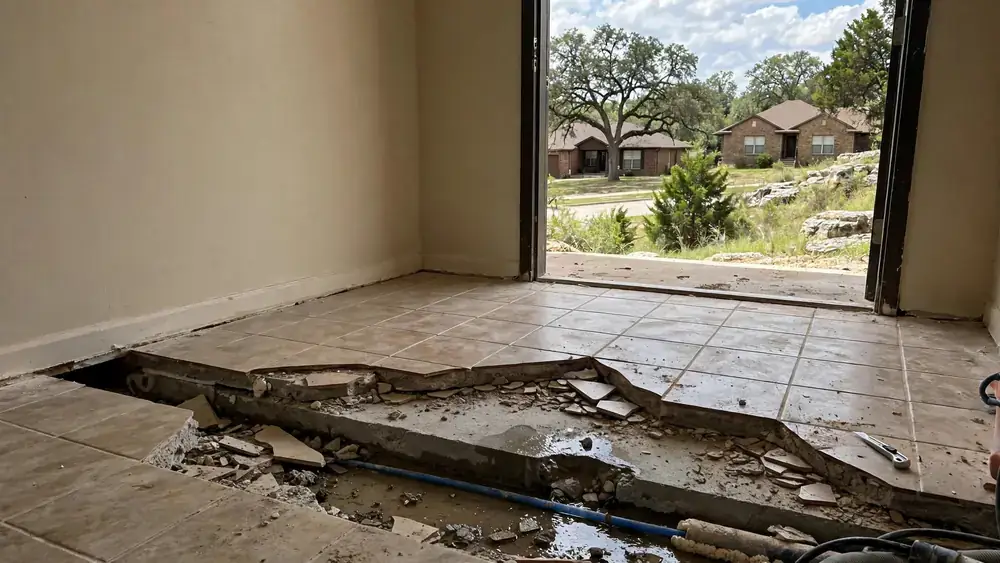
If a direct repair is the right call, expect dust, noise and some disruption. The plumber or a concrete crew will mark the location, protect the surroundings where possible and cut through the flooring and slab. The hole is usually modest, but it may take longer than expected, because older slabs can contain mesh or rebar and the pipe may not run exactly as drawn.
Ask about containment before anyone starts. Concrete dust travels, and in an older house the flooring being cut may need testing first. Once the repair has been done and tested, the trench is filled and patched, and the flooring is restored later, usually after the area has passed a moisture check. If it is a tiled floor, ask if any matching tiles are left in the garage. Older patterns may be hard to find, which can be a reason to think about a reroute instead.
Why rerouting has become so common
Plumbers often suggest rerouting a failed line through walls or the attic, rather than opening the slab. The old line is abandoned, and a new one, often PEX, runs to the same fixture. This avoids breaking up floors, and it moves that line to a place where any future leak is much easier to find. The trade-off is that walls may need small openings, and in a Texas attic the line needs proper insulation and protection from freezing.
Whether this is right for your home depends on the layout and on the condition of the rest of your plumbing. In a ranch with a simple plan, it may be straightforward. In a house with several later additions, the route can be more complicated. Ask the plumber to walk you through where the new line would go, and how it would be protected, before you agree.
What to do with flooring while you wait
If the leak has been found and you are waiting for repairs, pull back wet carpet and pad along the affected edge where you can safely do so, and let the area get some air. Move furniture away. Avoid walking on buckled laminate. Keep the area ventilated, and keep the water off if the plumber says that you should. Do not cover damp concrete with plastic, because that only traps moisture.
Take dated photos each day. If the affected area spreads, you will have a record of it, and you will also be able to show how quickly you acted. Keep children and pets clear of any lifted tack strips, since they are sharp. Small things like this rarely come up in conversation, yet they are often the difference between a tidy job and a miserable week.
Buying or selling a slab home in Richardson
If you are buying, ask about any past leak history and repairs, and ask for paperwork. A meter test takes minutes, and a sewer camera inspection can be well worth doing in an older house. A previous reroute is not a bad sign; it may mean someone has already dealt with a weak point. Look for patched flooring or abandoned lines as clues to that history.
If you are selling, keep every plumber's report and every moisture log. Buyers and inspectors in Richardson are used to older ranches, and a well-documented repair is far more reassuring than a vague memory. Texas sellers have disclosure duties as well, so ask your agent how past water damage should be described. Clear records will make that conversation much simpler.
How this differs from a foundation problem
Foundation contractors and plumbers often see the same house for different reasons. Sticking doors, cracks in brick and sloped floors usually point to soil movement, and that movement can happen with or without a leak. A leak can feed it by wetting the soil under one part of the slab. Equally, a slab moving for other reasons can stress a pipe until it fails. Cause and effect can run either way.
That is why it helps to separate the two. Have a plumber test the lines. Have an independent engineer look at the structure if there are real signs of movement. Then act on what they each found, in order. Fixing the water comes first, since it is the one thing that can keep getting worse every hour. Restoration then deals with what was wet, and any structural work follows when the picture is clear.
A note for homes with a water softener or filtration system
Softeners and whole-house filters can confuse a meter test, because they cycle and flush on their own schedule. Before testing, set yours to bypass, or test at a time when it is not regenerating. Also tell your plumber it is there. These units add connections close to where the main enters the house, and a small drip there can look like something much worse. Ruling that out takes a couple of minutes and can prevent a lot of worry about the slab.
Keep the report
File every leak report with your house papers.
Pools, sprinklers and false alarms
A moving meter does not always mean the slab. Irrigation valves, pool auto-fill lines and yard hydrants can all leak on the street side of your house valve. That is why the isolation step in the meter test matters. Turn off the irrigation at its own valve, and shut off a pool auto-fill before you run the test, so you are not chasing the wrong leak under the wrong floor.
FAQ
Slab leak questions in Richardson
How do I know if I have a slab leak?
Warm floor spots, running sounds, damp flooring and a meter that moves with everything off are the classic signs. Our slab leak signs guide goes through them.
Does a slab leak mean foundation failure?
Not by itself. It can contribute to movement, and a structural engineer can assess that separately if you see larger signs.
Can I keep using water?
If the leak is on the hot side, keep the hot supply off until it is repaired. Ask the plumber what is safe to use.
How is a slab dried?
With air movers, dehumidifiers and sometimes mats, tracked with meter readings. It can take longer than the walls above it.
Will my tile have to come up?
Only the part that gives access or is damaged, in many cases. Vinyl plank and laminate over wet concrete usually need to be lifted.
Why does the leak keep coming back?
Ground movement or the condition of old pipe can cause a new failure elsewhere. Ask if a reroute is a better fit.
Are newer homes at risk?
Yes, but less commonly from corrosion. Soil movement and installation damage can affect any slab.
Is a slab leak covered by insurance?
It depends on the policy, how the leak occurred and how long it ran. Ask your agent about both the damage and tear-out.