
Key facts: Burst Pipe Water Damage
- DFW reached -2°F in February 2021 and stayed at or below freezing for 139 straight hours [1].
- DFW averages about 29 freezes a season [2].
- The Texas Department of Insurance lists a burst pipe as sudden damage most policies cover [3].
- Texas plumbers are licensed by the Texas State Board of Plumbing Examiners [4].
Why Richardson pipes fail
Two different things burst pipes here. The first is cold. North Texas does not freeze hard very often, so builders have not always treated attic, garage and exterior-wall lines as seriously as in colder states. The February 2021 storm showed the result: DFW fell to -2°F and spent 139 hours in a row at or below freezing [1]. Ordinary winters still bring around 29 freezes a season [2], though most are short.
The second is age. Many Richardson ranches date from the 1950s through the early 1970s and may still have original copper or galvanized supply plumbing [5]. Galvanized steel corrodes from the inside and copper can pit, so a line may let go on a mild Tuesday in October with no weather to blame. Fittings, angle stops and flexible connectors under sinks and toilets fail in much the same way.
Ground movement adds a third stress. Clay soil swells and shrinks with rain and drought, and pipes fixed to a slab or running through it take some of that strain. That is the subject of our slab leak page, but it also matters at the point where a line rises out of the slab into a wall.
Why ice bursts a pipe somewhere else
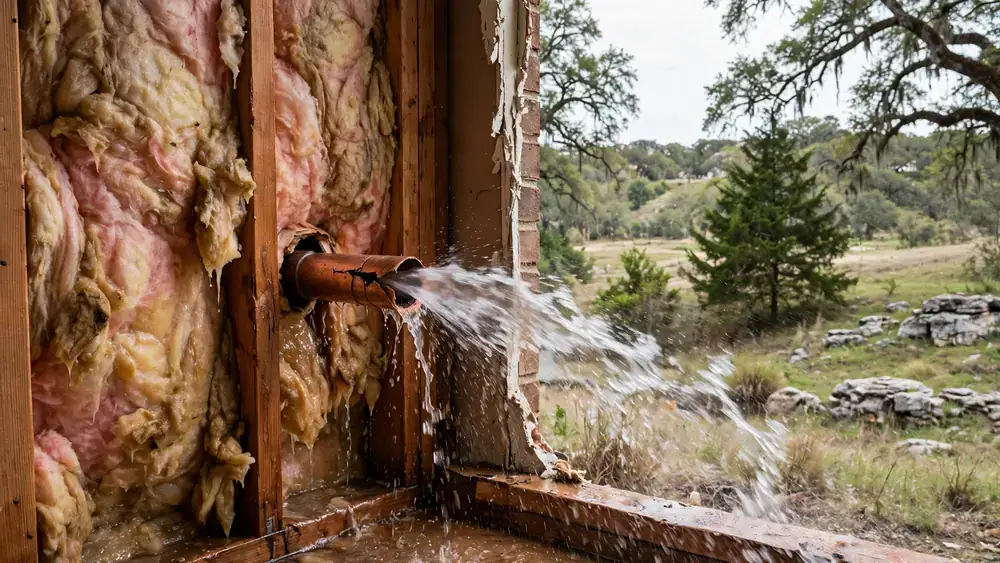
It feels logical that a pipe would split where the ice is, but it often does not. As an ice plug grows, it traps water between itself and a closed faucet. Pressure builds in that trapped section until the weakest point gives way, which can be some distance from the frozen part.
That is why a burst usually shows itself only during the thaw. While the line is frozen, the ice holds the water back. Once it melts, the split runs at full pressure. During a freeze, know where your main shut-off is and keep something near it to turn it with, because that moment may come at three in the morning.
Signs a line has failed behind a wall
Not every burst announces itself with a spray.
A sudden drop in pressure
Fixtures that sputter or weaken across the house can mean water is escaping somewhere before it reaches them.
A hissing or running sound
If you hear water with everything turned off, go and look at your meter.
Bubbling paint or wet baseboard
Water moving down a wall cavity shows itself at the bottom first.
A spinning meter
With all taps off, the leak indicator on the meter should not be moving.
What to do the moment a pipe lets go
- 1
Shut the main
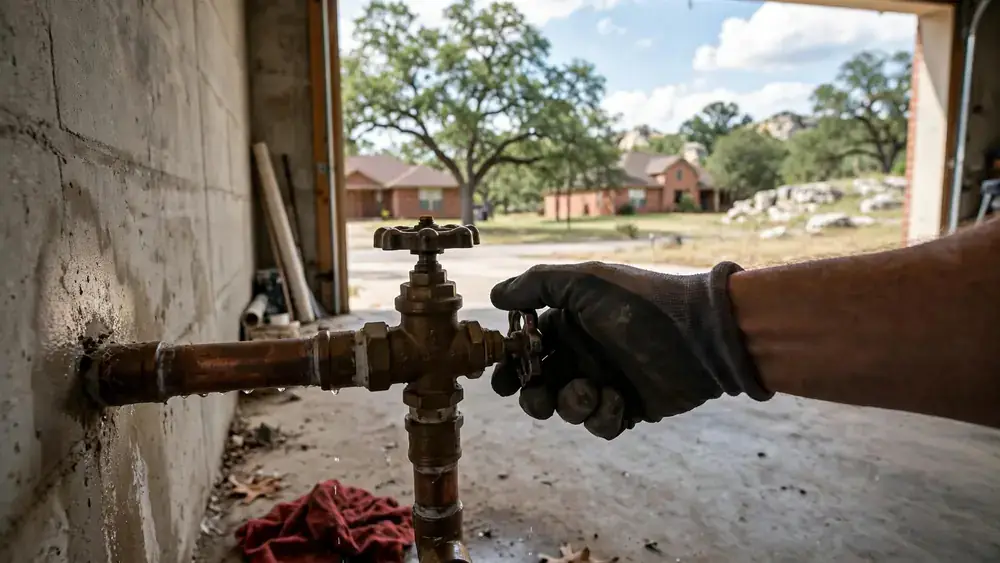
Turn the main shut-off, usually where the line enters the house. If you cannot find or turn it, the city-side meter is not a job for most owners; call for help.
- 2
Drain what is left
Open a low faucet, then a tub, so that water still in the lines goes down a drain and not through a ceiling.
- 3
Deal with the heater
If the water will stay off for some time, turn a gas water heater to pilot or switch off the breaker to an electric one.
- 4
Stay clear of power
Do not walk through water near outlets. Keep out from under ceilings that are bowing.
- 5
Make a record
Photograph the room, the pipe and anything damaged. Keep the failed section for your insurer if the plumber removes it.
- 6
Call for both trades
A plumber fixes the line. A restoration contractor handles the wet structure. Some firms do both; many do not.
Where a line tends to fail, and what gets wet
| Location | Usual trigger | What takes the damage |
|---|---|---|
| Attic line above a ceiling | Freeze, corroded fitting | Insulation, drywall ceiling, the room below |
| Exterior wall | Freeze | Wall cavity, baseboard, adjoining rooms |
| Garage wall or ceiling | Freeze | Stored goods, walls, door to the house |
| Hose bib | Hose left attached in a freeze | Wall behind the bib, sometimes indoors |
| Under a sink | Failed connector or angle stop | Cabinet base, floor beneath it |
| At a slab penetration | Soil movement, corrosion | Flooring, bottom plate, slab edge |
Attic lines
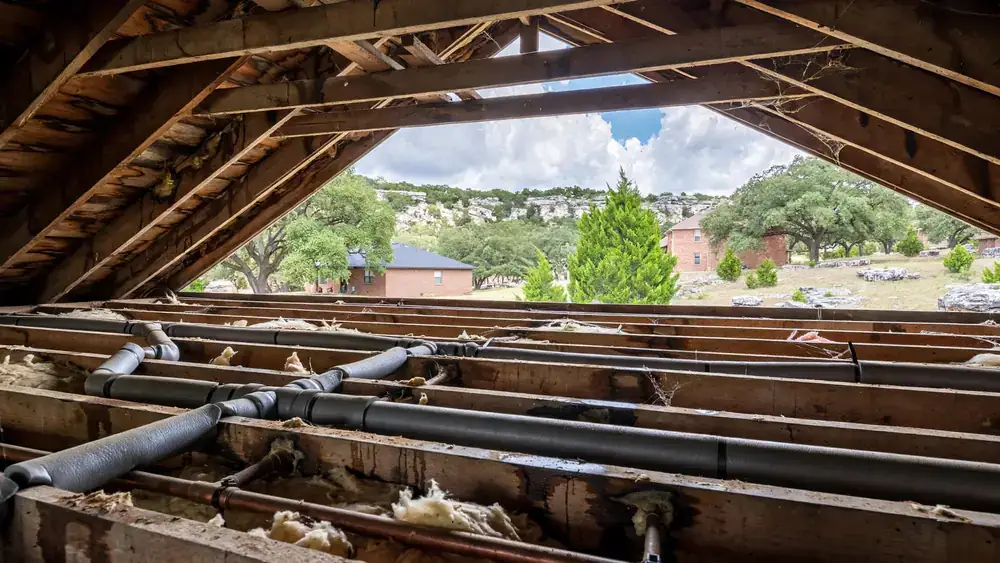
A line in the attic is a whole-house problem
Water from an attic line falls through insulation first. Blown or batt insulation soaks up a great deal before it passes it on, and the ceiling drywall then carries that weight. A bulge in a ceiling is a warning sign. Keep people out from beneath it, and if it has to be relieved, leave that to someone equipped for it.
Wet insulation usually comes out, because it holds water against the ceiling and loses its effect. Light fixtures and ceiling fans are possible paths for water, so power to that circuit needs thought before anyone goes up a ladder.
How the water damage gets handled after the repair
Once the plumber has made the line safe, drying starts. Supply-line water usually begins as Category 1 clean water, which is good news, because more of the structure can often be dried where it stands. That window closes, however: water sitting in a wall or carpet for days becomes less clean, and a slow discovery after a vacation can change the whole job.
The sequence then follows our extraction and drying process. Remove the water, map the wet zone, open what has to be opened, run the equipment and record the readings. Ceiling and wall cavities may need opening so that air can reach them. Insulation, once wet, is usually replaced rather than dried.
Ask to see the wet map. It shows you why the work extends beyond the room you first saw, and it stops arguments later about why a neighboring closet needed drying.
Pipe repair and permits in Richardson
Plumbing in Texas is a licensed trade, regulated by the Texas State Board of Plumbing Examiners [4]. Ask for the license number and look it up. Replacing a whole line or repiping a house is likely to involve a permit from Richardson Building Inspection, which requires permits to be posted before work begins. For rules on your specific repair, the city's general permit line is 972-744-4180.
If you are seeing repeat leaks along the same run, ask the plumber whether a section repair is still sensible or whether it is time to talk about the whole line. Repeated pinholes in old copper or heavy scale in galvanized pipe usually mean the material is near the end of its life, and that is a condition question for a plumber to answer on site.
Pipe materials you may find in a Richardson house
| Material | Where it is seen | What tends to happen |
|---|---|---|
| Galvanized steel | Older homes, sometimes partly replaced | Internal rust, reduced flow, leaks at threads |
| Copper | Many homes from the 1950s on | Pinholes, especially at bends; generally long-lived |
| CPVC | Some later homes and repairs | Can turn brittle with age and heat |
| PEX | Newer homes and repipes | Flexible; tolerates freezing better than rigid pipe but not immune |
| Flexible connectors | Every sink, toilet and washer | Age and corrosion; easy to overlook |
How Texas insurers tend to treat a burst
The Texas Department of Insurance names a burst pipe among examples of sudden and accidental damage that most home and renters policies cover, while gradual leaks usually are not [3]. Usually the claim is about the damage the water caused; the pipe repair itself may be treated differently. Your policy wording decides.
Your duty to protect the property matters here, because insurers can deny claims when owners do not take reasonable steps. Stop the water, start drying, keep your receipts and call your insurer early. If the house was left empty during a freeze, check any conditions in the policy about heat and vacancy. There is more in the Texas insurance guide.
Winter habits that protect a Richardson house
- Disconnect hosesTake hoses off outdoor faucets and fit an insulated cover before the first freeze.
- Know the mainFind and exercise the valve once a year, so it turns when you need it.
- Let lines dripIn a hard freeze, a slow drip at the faucets on exterior walls keeps water moving.
- Open cabinetsLet room air reach pipes in cabinets against outside walls.
- Check attic insulationPipes should be covered on the cold side, not exposed in a gap.
- Plan for travelIf you leave in winter, shut the main and leave the heat on.
Getting the water back on without causing a second flood
After a freeze or a repair, restore water slowly. Open the main a little at a time, with someone listening in the attic or walking the house. Leave a faucet open to bleed air. Fully opening the valve can knock loose scale from old pipes or reveal a second split that had been sitting quietly.
If you are in the wake of a citywide freeze, plumbers and restoration firms will be busy and the supply of parts may be thin. Stopping water, drying what you can and keeping good records still protects you while you wait. Also check nearby rooms and closets, because a house that split one line in a freeze may have split another.
When the leak is on the city side
If water is running in the street, alley or at the meter box, the leak may not be yours. The City of Richardson lists water leaks among the problems its 24/7 Response Center takes at 972-744-4111 [6]. Report it there, and record any water that reached your property.
What a burst usually looks like, room by room
In a bathroom, the failure is often a supply connector behind a toilet or under a vanity. Water spreads quickly on tile, finds the door threshold and moves into the hallway carpet. Because bathrooms sit back to back with bedrooms in many ranch plans, the closet on the far side of the wall may be the first thing to show damage.
In a kitchen, the dishwasher line, the ice maker feed and the sink stops are the usual suspects. All of them are hidden, and all can run for a while before anyone notices. In a garage, a split line on an outside wall may pour onto the concrete, which looks harmless until water passes under the door into the house. In an attic, the first sign is often a light fixture dripping or a ceiling starting to bow.
Laundry rooms deserve special mention, because the hoses behind a washer are under constant pressure even when the machine is off. Rubber hoses in particular harden with age. Turning off those valves before a trip is a small habit that avoids a very common loss.
When the house was empty
A burst during a vacation or a business trip is a different kind of loss. Water may have run for days. Ceilings can come down, wood floors can buckle across several rooms, and clean water will have turned into something less clean. Mold may already be visible. Expect more removal, and more careful record keeping about when the house was last occupied and whether the heat was on.
If that describes your situation, do not rush back into the rooms. Check for electrical hazards and fallen ceilings from the doorway first. Take video before you touch anything, then close the main. Tell your insurer about the timeline straight away. It helps to know who last visited, and any smart thermostat or water meter data that shows when things changed can be useful evidence.
What the February 2021 storm taught North Texas
Many Richardson owners still remember the 2021 freeze. It showed how much of the plumbing here relies on mild winters. It also showed what happens when every plumber in a region gets the same call on the same day. People waited, parts ran short, and homes that could have been dried in days sat wet for much longer.
The lesson is mostly about preparation. Know your shut-off. Keep a basic wrench nearby. Keep a phone charger and a flashlight where you can reach them. Do the simple winter jobs before the forecast turns. When a storm like that does arrive, closing the main early and draining your lines can be better than hoping for the best, particularly if you expect to lose power. Ask your plumber whether this makes sense for your house.
Pressure, water hammer and other quiet causes
Not every failure comes down to age or cold. Very high water pressure strains every joint and connector in the house. A plumber can test pressure with a simple gauge, and a pressure-reducing valve can be fitted or replaced if it is out of range. Water hammer, the bang you may hear when a valve closes quickly, sends shocks through pipework and can loosen fittings over time.
Hard water matters as well. North Texas water leaves mineral deposits that build up in fixtures and heaters, and any repair that mixes metals without proper fittings can corrode more quickly. These are details for your plumber, but it is useful to mention bangs, pressure swings or a history of repeated leaks. They can explain why a line failed when nothing seemed to be wrong.
Water heaters: the other burst
A water heater is a pressure vessel holding a large amount of water, and when a tank finally rusts through, it can release all of it. In Richardson these may sit in a garage, a closet or an attic. Attic and closet units should have a pan and drain, but pans overflow when a tank lets go quickly. Rust at the base, dampness or a rumbling sound are all reasons to have it looked at.
If the tank is leaking, shut off the cold inlet above it, turn off the gas or the breaker, and let the plumber take it from there. Then treat the surrounding area like any other clean-water loss. Check the wall behind the unit, the adjoining rooms and, if it is in an attic, everything below. A tank failure in a closet near a bedroom tends to soak carpet in two or three rooms before it is found.
Questions to ask the plumber before they leave
Ask what failed and why, and get that in writing. Ask whether the failed part is available for your records, whether the rest of the line looks sound and whether the water can safely go back on. Ask if any other lines were affected, and whether a pressure test is sensible after a freeze. If drywall was opened to reach the pipe, ask them to leave the opening clear for the restoration crew, since it may be useful for drying.
Pass all of this along to your restoration contractor and your insurer. A clear cause of loss, in the plumber's own words, removes a lot of uncertainty from what comes next. A photograph of the failed section, with the date, is a simple thing to take and it often answers a question that would otherwise take several phone calls.
A quick word on smart shut-offs and leak sensors
Small battery sensors placed under sinks, by the water heater and behind the washer can alert your phone the moment they get wet. Whole-house automatic valves go further and close the main when they detect unusual flow. Neither replaces knowing where your shut-off is, but they can turn a day-long flood into a small puddle, especially if you travel. Ask your plumber what suits your house, and whether your insurer gives any recognition for having one.
Hose bibs are the classic Richardson surprise
An outdoor faucet can split inside the wall and show nothing all winter. The first sign often comes on the first warm day of spring, when somebody turns on the hose and water runs into the wall instead. Check the wall behind each hose bib the first time you use it, and stand inside to listen while it runs.
FAQ
Burst pipe questions in Richardson
Should I call a plumber or a restoration company first?
Close the water, then call the plumber to make the line safe. Call restoration at the same time, since drying should not wait on the repair.
Why did my pipe burst when it was not cold?
Corrosion, a weak fitting, high pressure or a failed connector can all do it, especially in an older Richardson house with original lines.
Will the ceiling need replacing?
Not always. Clean-water ceilings can sometimes be dried, but sagging drywall or soaked insulation usually means that section comes down.
Is a burst pipe covered by insurance in Texas?
Most policies cover sudden damage such as a burst pipe. Check your own wording, and report it promptly.
Where is my main shut-off?
In many North Texas homes it is near where the line enters the house, in the garage or by a front hose bib. Find yours before you need it.
Can I use the house while the plumber is on the way?
Yes, if there is no electrical risk, but with the water off. Do not flush or run taps unless the plumber says that is fine.
Do pipes in an attic need insulation in Texas?
Attic pipes need protection from cold air. Ask a plumber or insulation installer to look at yours, because exposed lines are a repeat freeze risk.
How do I know whether all the water is gone?
You cannot tell by touch. Ask for meter readings of the walls, floor and ceiling around the leak.