
Key facts: Breckinridge Park Estates
What sets 75082 apart
ZIP 75082 covers the northeast of Richardson, much of it on the Collin County side of a city that spans two counties. Statistical Atlas places Breckinridge Park Estates here, within Plano ISD. In general this part of town developed later than the central city, so the typical house is larger and the typical failure is different.
In place of the original cast iron of a 1950s ranch, you are more likely to be dealing with an attic air handler, an upstairs laundry, a second-floor bath or a burst water heater in a closet. Water that starts high in a house does more on its way down. That is the pattern we keep in mind throughout this page.
Breckinridge Park Estates and nearby streets
Larger two-story homes bring long plumbing runs, more bathrooms and more connected appliances. A failed washing machine hose on the second floor can run for hours while the family is out. An ice maker line behind a fridge can seep for weeks. These are simple parts that nobody ever thinks about until the ceiling below marks the spot.
Slab homes here also sit on the same North Texas clay as the rest of the city. Newer construction does not rule out a slab leak, but in younger houses it is more likely to come from ground movement or installation than from corrosion. Keep your builder and warranty paperwork where you can find it, and check with a plumber if you get a warm spot or a rising meter.
Trails and green space nearby are part of the appeal of the area. Lots backing onto parks or channels can receive sheet flow in hard storms. If your back fence borders a green belt, look at how the yard slopes in relation to the patio door and the slab.
Where water starts in a 75082 home
| Source | Warning sign | Prevention |
|---|---|---|
| Attic air handler | Ceiling stain in summer, dripping secondary drain | Seasonal drain service, float switch |
| Upstairs washer | Stain below the laundry room | New hoses; shut off when away |
| Water heater in a closet or attic | Rust or dampness around the base | Check the pan and drain; plumber inspection |
| Shower pan | Stain under the bath, wet baseboard nearby | Keep grout sound; have it tested |
| Refrigerator line | Cupped floor by the kitchen | Check the connection when moving the fridge |
Regional water lines in the northeast
Not all water in Richardson comes through the city's own pipes. In 2018 a North Texas Municipal Water District transmission line broke in northeast Richardson, and the city later reported on its sewer and stormwater impact evaluation. Events of this kind are rare, but they show that large lines run through this area. If water appears at the surface or in your yard, do not assume it is yours. Report it at 972-744-4111, and photograph anything that reaches your property.
Who you are dealing with in Collin County
Being in Collin County does not change who runs your city services, as Richardson provides water, sewer and building inspection across both counties. It can change other things, such as your county appraisal and some emergency planning. For water damage, the practical point is that permits still go through City of Richardson Building Inspection, and that the same 24/7 line applies.
If you live in an association, read its rules before any repairs. Exterior work, shared fences and common areas may need approval, and the association may hold a master policy in a townhome or condo community. Find out what it covers before you assume either way.
When a leak starts upstairs
- 1
Close the water
Close the fixture valve or the main shut-off.
- 2
Check the room below
Look for bulging or dripping. Keep people out from under any sag.
- 3
Mind the lights
If water is coming through fixtures, switch off that circuit if you can reach it dry.
- 4
Follow the path
Look at closets, stairs and walls below the source, as water spreads along framing.
- 5
Record
Photograph both floors before moving anything.
- 6
Call
Describe the upstairs source and what you see on the lower floor.
Getting drying right in two stories
Water that has passed through a floor sits in places a fan cannot reach. The subfloor and the space between floors hold moisture, and insulation can hold more. A contractor may need to open a ceiling section or vent cavities to dry them. Expect readings on both levels, and ask to see them. The EPA's 24 to 48 hour target is hardest to meet here, and that is a good reason to call early.
Floors above may include hardwood, carpet or tile on a wood subfloor. Water beneath tile can sit in the subfloor for a long time. Tell the crew how the bathroom is built, if you know, and ask if a section of ceiling below will be easier to reach than the floor above.
Insurance details for newer homes
Most Texas home policies cover sudden water damage, like a burst hose, but not gradual leaks. Shower pans and slow drips are where owners can get caught out. If a stain has been slowly growing, get it looked at now. Newer homes may still have some builder paperwork or warranties in place, so check those documents, and keep a dated record of when you first noticed the problem.
Pools, sprinklers and yards
Many homes here have sprinkler systems and some have pools. Sprinkler lines and heads may spray onto the slab edge and brick, and a leaking line can keep soil wet beside the foundation. Pool lines can also leak underground. If your meter test shows a leak with the house main closed, the yard is a good place to look next. Run sprinklers while you watch them once in a while, especially after any landscaping work.
A wet strip along the foundation can look like a slab leak indoors, so check the outdoor side first when a wall bottom gets damp and there are no plumbing lines nearby. A flood check against FEMA's map service is sensible if your lot borders a channel.
Five checks for a Breckinridge Park Estates home
- Replace washer hoses and shut off the supply when you travel
- Fit water alarms under the upstairs laundry and water heater
- Check the secondary AC drain in the first hot weeks
- Review the shower pan and grout upstairs
- Keep your HOA or master policy documents handy
How northeast Richardson developed
While the center of the city filled up in the 1950s and 1960s, the land to the northeast stayed open for longer. Later subdivisions brought larger homes, and more recently the CityLine district added offices, apartments and retail on a different scale from the rest of the city. So 75082 is mostly a story of later construction, with materials and layouts that reflect modern habits: more bathrooms, more appliances, more equipment up in the attic.
Later does not mean problem-free. As homes from the 1980s and 1990s pass their thirtieth and fortieth years, water heaters, roofs, shower pans and supply lines are all reaching replacement age. CPVC or older polybutylene pipe may appear in homes of certain ages, so ask a plumber what yours has. Polybutylene is known for failing, and if you have it, you should know about it before it lets you down.
Water heaters in closets and attics
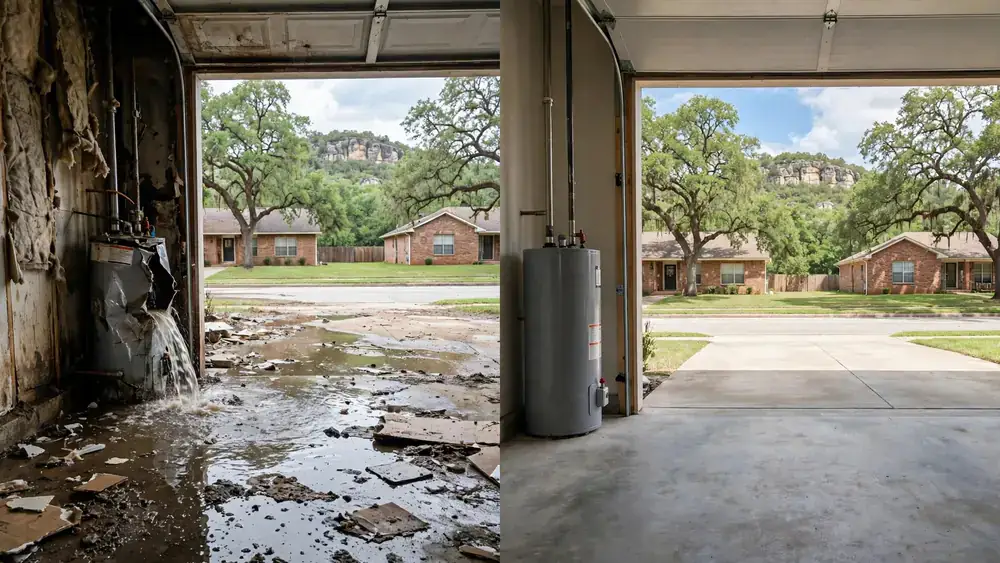
In larger homes, water heaters often sit in a closet or the attic to shorten hot-water runs. It is a convenient place until the tank fails. A pan and a drain line can catch a small leak, though not a sudden tank rupture. In an attic, this means gallons of water heading straight down through a ceiling. Find out the age of your tank by looking at the label and serial number, or by asking a plumber.
Consider a water alarm in the pan, and an automatic shut-off if your plumber recommends one. Know where the cold-water inlet valve is, and make sure that it turns. If you see rust, moisture around the base or a rumbling sound, have it looked at. A planned replacement on a quiet Tuesday is a far better day than the unplanned kind.
Master baths and big showers
Large showers, soaking tubs and double vanities are features of many homes here. Each adds lines, drains and seals, and most of them sit over a ceiling. Shower pans are a frequent cause of slow leaks. Water passes through the grout, reaches the pan and should run to the drain. If the pan is cracked, or the seal has failed, it escapes into the floor below instead.
Early signs are a stain on the ceiling below or damp carpet beside the shower wall. Because that kind of leak is slow, it can be treated as gradual by an insurer. So keep an eye on the area. Re-grout and re-seal when needed, and take any new mark seriously. A plumber can run a pan test by plugging the drain and filling the shower pan to see what happens.
Moving into a newer home: a first-week checklist
New owners in Breckinridge Park Estates often have never had to think about any of this. In your first week, find the main shut-off and the water heater valve, and look at the AC pan and the secondary drain outlet. Label the breaker panel. Check the age of the water heater, roof and AC, and ask the seller for any records of past leaks. Then look under each sink and behind the washer.
If there is an association, get a copy of its rules. Add reminders to change filters and to test the meter. These jobs take an afternoon, and they mean that if anything does go wrong, you will know exactly where to put your hand. That knowledge turns a frightening moment into a manageable one, and it is the single best thing that you can do for your new home.
When storms hit newer roofs
Hail does not care how new a roof is, and big two-story houses have long roof lines with complex valleys. Wind-driven rain can enter at ridge vents, and hail can crack vents and skylights. After a storm, check your attic with a flashlight if it is safe to get there. Look for damp insulation or daylight in places you would not expect it. If a neighbor has roofers working next door, be cautious about anyone who offers a free look and then asks you to sign.
Take photos of hail on the ground if you can, with the date. Tell your insurer soon after, and find a roofer of your own choice. If water has entered, a restoration contractor should look at the ceilings and insulation, because roof work alone does not dry anything. Keep the two jobs and their paperwork clearly separated, so that each is finished properly.
Who to call in Breckinridge Park Estates, in order
In a house, close the fixture or the main, then call a plumber and a restoration contractor. In a managed building, call the front desk or management first, as they control the shut-offs. For water surfacing in a street, a yard or a green space, use the city line. For gas smells or danger, leave and call 911. Keep your association contact, your insurer and your plumber saved in your phone.
With larger homes, it also helps for everyone in the house to know two valves: the main shut-off and the one for the water heater. Show older children and anyone who looks after the house when you travel. If you have a smart leak sensor, make sure that more than one person receives its alerts.
Young homes with first-time failures
Many owners here have never had a leak, so the first one is a shock. The most frequent first-time failures are simple parts: a braided connector under a sink, a fill valve in a toilet, a washer hose or a condensate drain. They wear out quietly on a similar schedule across a neighborhood, which is why several houses on one street can have the same problem within a few years.
A short annual walk-through finds most of them. Look under every sink with a flashlight, listen for toilets that keep running, and check around the base of the water heater. If you see a green crust on a fitting, or a connector with a bulge, have it replaced. This is a small routine job, and it is much easier to do on your own schedule.
Second-floor laundry habits
Run the washer only when someone is home and awake, so that a burst hose gets noticed within minutes and not hours. Turn off its supply valves before a trip, and fit a drain pan with an alarm if yours lacks one. A failed hose upstairs remains one of the most common and most avoidable losses in this part of town.
Refrigerators, ice makers and open-plan kitchens
Open kitchens are popular in newer northeast Richardson homes, and hardwood or engineered floors often run straight through into the living areas. An ice maker line behind the fridge can seep unnoticed, and the first sign may be cupped boards several feet away. Pull the fridge out once a year, check the line and its connection, and look at the floor beneath. Dishwashers deserve the same care, as a small leak under one can travel along the underlayment.
FAQ
Questions from Breckinridge Park Estates homeowners
Do you serve Breckinridge Park Estates?
Yes, homes with a 75082 ZIP code are covered.
Is Collin County handled differently?
City services are the same in Richardson. Your permits still go through City of Richardson Building Inspection.
Why is the stain below my laundry room?
A washer hose, drain or pan is a likely source. Shut off the supply valves and call.
My house is fairly new. Can it have a slab leak?
Yes, though it is less common. Soil movement or an installation problem can cause one.
Who do I call about water coming up in my yard?
Report it to the city at 972-744-4111, as it may be a public line.
Does my HOA pay for this?
It depends on your association documents and master policy. Read them, then ask the association in writing.
Sources and citations
- [1]Statistical Atlas: Breckinridge Park Estates
- [2]Wikipedia: Richardson, Texas
- [3]City of Richardson: 24/7 Response Center
- [4]City of Richardson: Residential permit types
- [5]Texas Department of Insurance: Water damage and mold coverage
- [6]FEMA Flood Map Service Center
- [7]US EPA: A brief guide to mold, moisture and your home